Free Nationwide Delivery*
 Split Packs Availible
 Price Match
 Trade Accounts

Indian Sandstone Paving Colours: A Guide to Types & Finishes
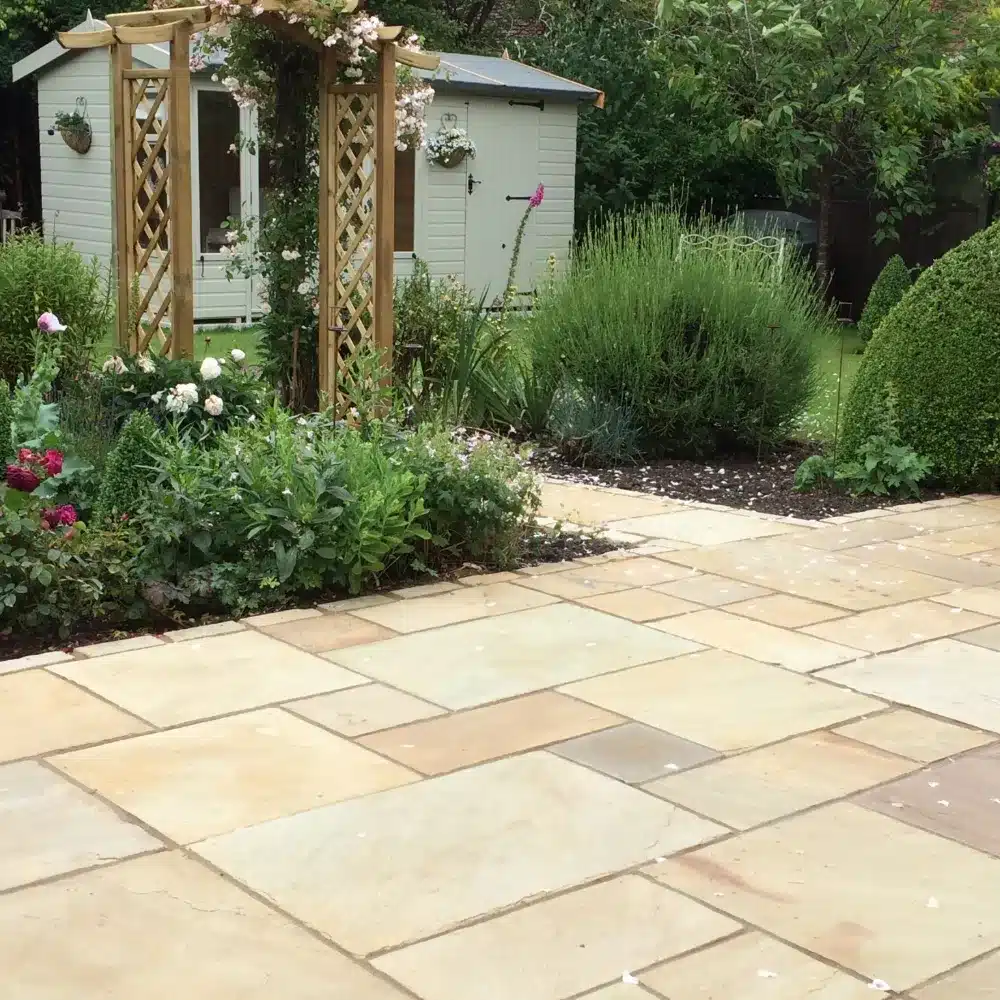
Choosing Indian sandstone paving starts with the colour, but it should not end there. A grey slab with a riven face looks and feels different from smooth honed sandstone, while the same warm blend can create quite a different patio in large rectangles or mixed sizes.
This guide compares the sandstone colours in our range and explains the terms you will see on product pages. Use it to narrow down your favourites, then compare samples, finish and pack details before ordering your Indian sandstone paving slabs.
Indian sandstone colours at a glance
Sandstone is quarried natural stone. Its colour and markings vary between pieces, so choose a range for its overall palette rather than expecting every slab to match a single photograph. The descriptions below are a starting point; packs and batches can contain lighter, darker and contrasting pieces.
| Range | Colour character | A useful starting point for |
|---|---|---|
| Kandla Grey | Silver-grey through to deeper grey, with natural tonal movement. | Cooler palettes, rendered walls and a restrained garden scheme. |
| Raj Green | Muted green, grey, brown and buff blended across the paving. | Brick houses, mature planting and a traditional garden feel. |
| Raj Blend | Earthy brown and buff with grey and subtle green tones. | A warm, varied patio alongside timber or mixed brickwork. |
| Camel Buff | Golden-buff and warm sandy tones with natural variation. | A softer, warmer alternative to grey paving. |
| Rippon Buff | Buff, honey and cream with earthy colour movement. | A warm patio where variation is part of the design. |
| Fossil Mint | Pale cream, beige and buff with natural markings and occasional fossil detail. | A lighter natural stone palette with visible character. |
| Ivory Mint Honed | Soft ivory, cream and buff in a smoother sawn and honed finish. | A more refined surface while retaining natural stone variation. |
| Autumn Brown | Richer browns with buff and earthy tones. | Rustic settings, warm brickwork and timber features. |
| Raveena | Purple and lilac variation against grey and buff tones. | A more expressive colour blend rather than a quiet neutral. |
These are design suggestions, not rules. Compare the stone against your own walls, window frames and planting. Availability differs between colours, sizes and finishes, so check the current listings rather than assuming every combination is offered.
Which sandstone colour should you choose?
Kandla Grey for a cooler, simpler palette
Kandla Grey is a useful first comparison if you like grey paving but want the texture and variation of real stone. It can sit comfortably beside pale render, dark window frames or red brick. Look at a spread of slabs: a natural grey patio will have more movement than one small swatch suggests.
Check the material as well as the name when shopping. Kandla Grey is also used to describe some porcelain products; sandstone and porcelain need different installation and care choices.
Raj Green or Raj Blend for an earthy mix
Raj Green is not a solid green slab. Its appeal is the mixture of green-grey, brown and buff across a larger area. Raj Blend also sits within an earthy palette, with warm brown and buff alongside grey and green.
We list Raj Green and Raj Blend as separate ranges. Compare their own photographs, samples and specifications rather than assuming the names guarantee an identical stone selection. A multi-tonal patio can pick up several colours already present in brickwork or garden walls.
Camel Buff and Rippon Buff for warmth
If a cool grey feels too stark against your house, start with these warmer choices. Camel Buff has a golden, sandy character; Rippon Buff brings buff, honey and cream with earthy variation. Neither should be treated as a uniform beige.
Try the sample against the brickwork in both sun and shade. Joint colour matters too: a contrasting joint makes the pattern more visible, while a closer colour can make the paved area read more as one surface.
Fossil Mint or Ivory Mint for a pale patio
Fossil Mint combines light cream, beige and buff with individual markings. Fossil detail is occasional, so do not expect the same feature on every slab. Ivory Mint Honed offers a smoother face in a pale palette, with natural pores and markings still visible.
Colour names alone do not tell you how the surface will feel. Compare the riven and honed options in person if possible. Pale paving also makes some everyday marks more noticeable, so consider leaf fall, pots and barbecue areas when planning its care.
Autumn Brown and Raveena for stronger character
Autumn Brown brings a deeper, earthy palette that works particularly well where a light patio would feel out of place. Raveena offers a different direction, with purple and lilac movement mixed into grey and buff.
For these more varied ranges, a photograph showing several laid slabs is especially useful. One small sample cannot show the full balance of colours across a patio.
Why sandstone looks different when wet
Rain usually deepens sandstone colours and makes contrasts and markings more apparent. Dry paving may look softer or paler. A photograph taken just after rain can therefore give a different impression from the same stone on a dry afternoon.
View samples outdoors and wet them with clean water as well as looking at them dry. Let them dry again before deciding. This helps you understand the colour range, but it does not reproduce the precise result of a sealer. Some sealers enhance colour while others aim to leave a more natural appearance; always test the chosen treatment first.
During laying, mix suitable slabs from different parts of the packs to spread the natural variation. Check pieces before fixing them, and raise any suspected damage or quality concern before installation.
Riven, sawn, honed and calibrated: what do they mean?
These terms describe different parts of the specification. A slab can be riven on top, sawn at the edges and calibrated underneath at the same time.
| Term | What it describes | What to check |
|---|---|---|
| Riven | A textured face formed by splitting the stone along its natural layers. | Surface variation and whether the texture suits your setting and furniture. |
| Hand-cut or hand-dressed | Edges with a more traditional, irregular appearance. | Dimensional tolerance and the recommended joint width. |
| Sawn edge | Machine-cut edges for a straighter outline. | The top face separately: sawn edges do not automatically mean a smooth slab. |
| Honed | A worked, smoother surface. | Outdoor suitability, slip-performance information and product-specific care. |
| Tumbled | Processing that softens edges and gives a more aged appearance. | The actual face and finish; not every colour or size is offered tumbled. |
| Calibrated | The underside is machined towards a stated nominal thickness. | The thickness and tolerances. Calibration does not remove the natural texture above. |
A textured surface should not be described as slip-proof. Any paving can become slippery when wet, dirty or covered with algae. Choose the individual product for the location and keep it clean.
600 × 900 sandstone slabs or mixed-size patio packs?
600 × 900 mm Indian sandstone slabs use one main rectangular format. They suit a repeated layout and make it easier to plan a regular arrangement. Dry-plan the edges and cuts with your installer before choosing the pattern.
Mixed-size sandstone patio packs combine different slab dimensions for a more varied layout. Follow the laying pattern and size mix for the actual pack. Pack coverage, slab counts and nominal dimensions are not universal between products.
Our wider range also includes selected 600 × 600 mm slabs and sandstone planks. Some lines are nominally 18 mm thick and others 22 mm. Read the exact specification instead of choosing by colour name alone, and do not assume a thicker patio slab automatically makes a driveway suitable.
Complete the patio with sandstone circles and setts
A sandstone paving circle can define a seating area or introduce a curved feature within a larger layout. Sandstone cobble setts can form edging, frame a circle or add a contrasting detail along a path.
Check the colour, finish and dimensions of these pieces independently. A matching name does not promise an exact shade match between slabs, circles and setts, and not every sandstone colour is available in every format. Plan their levels and joint widths together before work begins.
Before you order: samples, quantities and care
- Compare more than colour. Order sandstone paving samples where available and check the face, edge and texture. View wider product photographs to understand variation.
- Measure the layout. Allow around 10% extra for cuts and selection as a starting point, with more for complex patterns or awkward shapes. Confirm the amount with your installer and check whether your calculator selection already includes an allowance.
- Compare the full order cost. Check coverage, VAT, quantity options and delivery for your postcode. Any split-pack handling charge needs to be included in the comparison; a headline price per square metre may refer to a different order option.
- Agree the construction. Patios need suitable support, drainage and installation materials. Read our paving installation guidance alongside the chosen product’s instructions. Vehicle areas need a specification designed for the expected loads.
- Plan simple maintenance. Sweep regularly and use a cleaner suitable for the stone and jointing product. Follow the manufacturer’s instructions before pressure washing or applying a sealer; sealing does not replace cleaning.
Indian sandstone paving FAQs
What is the best Indian sandstone colour?
The best choice depends on your house and the effect you want. Compare Kandla Grey for cooler tones, Raj Green and Raj Blend for an earthy mix, buff or mint ranges for warmth and lightness, and Autumn Brown or Raveena for stronger colour movement.
Is Raj Green sandstone actually green?
It is a blend rather than a single green shade. Expect muted green alongside grey, brown and buff, with variation between slabs. Look at several pieces to judge the overall palette.
Is calibrated sandstone smooth?
No. Calibration refers to machining the underside towards a nominal thickness. Calibrated sandstone can still have a riven face. Look for the separate surface-finish description if you want smoother paving.
Does sandstone need sealing?
There is no single rule for every sandstone product. A compatible sealer may help with stain resistance or alter the colour, but suitability depends on the stone, finish and treatment. Check the product guidance, test an inconspicuous area and follow the specified drying and curing conditions.
Will a sandstone sample match the whole patio?
A sample helps you assess colour and texture, but it represents only a small part of a naturally varied material. Use samples alongside wider photographs and expect differences between individual slabs.
Find the right sandstone for your garden
Start with two or three colour families, compare them wet and dry, then choose the finish and layout. Browse our Indian sandstone paving range or contact our UK-based support team for help comparing the current options. You can also visit our Fareham showroom to discuss the project before ordering.