Free Nationwide Delivery*
 Split Packs Availible
 Price Match
 Trade Accounts

Paving Slab Laying Patterns: 5 Patio Layouts Explained

The paving you choose sets the tone for a patio, but the laying pattern is what brings the whole design together. A single-size porcelain slab can create a clean, contemporary terrace; a mix of sandstone sizes gives a softer, traditional finish. Neither is automatically better — the right pattern depends on your paving size, garden shape and the look you want.
This guide compares five practical paving slab laying patterns and explains how to choose between them. Once you have an idea, explore our Indian sandstone paving, porcelain paving slabs and mixed-size sandstone patio packs.
1. Stretcher bond: a neat, staggered patio
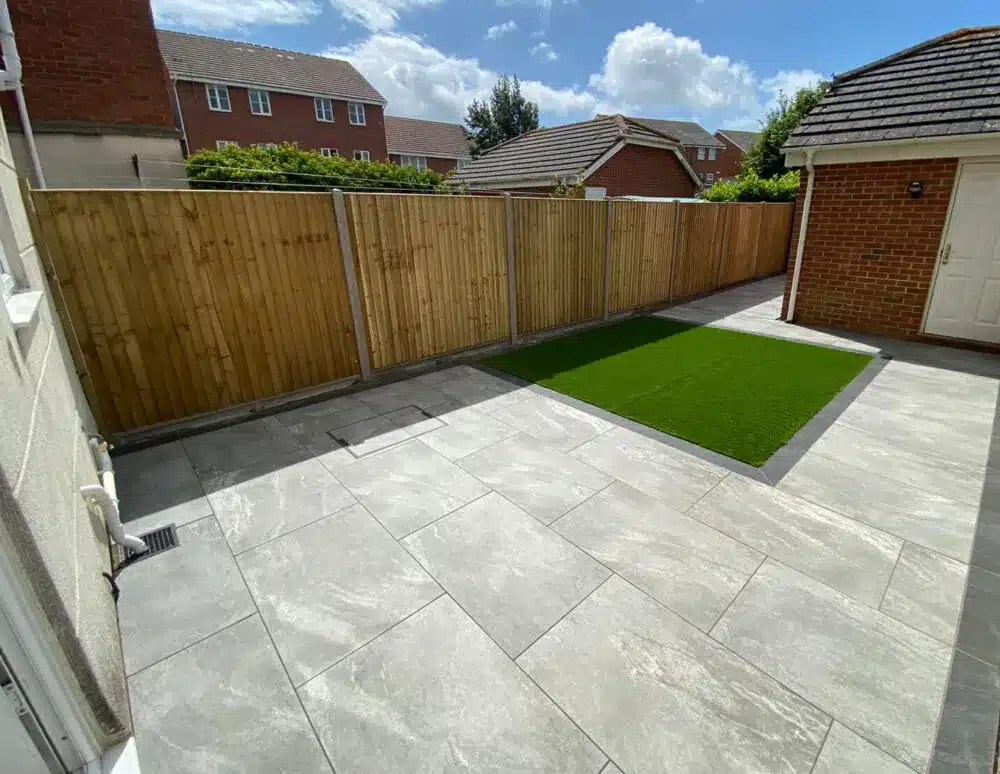
Stretcher bond, also called running bond, uses rows of rectangular slabs with the joints offset between neighbouring rows. It is particularly effective with 600 × 900 mm paving slabs because the long lines make a patio feel orderly without creating a full grid.
You can orient the long sides to draw the eye towards a seating area or run the rows across a narrow garden to change how the space feels. Choose the offset carefully: half-bond is common, but a one-third offset may be preferable for some large-format porcelain products. Always follow the specific manufacturer’s guidance on offsets and allowable lippage.
Best for: contemporary patios, paths and rectangular spaces. Browse 600 × 900 mm porcelain paving and 600 × 900 mm sandstone paving.
2. Stack bond: straight joints and a modern finish
With stack bond, slabs line up in a grid so the joints run continuously in both directions. Square 600 × 600 mm porcelain slabs look particularly crisp in this arrangement; rectangular paving works well too.
There is little room for uneven setting-out: any wandering joint is easy to spot. Establish accurate string lines, consistent gaps and the correct fall before you start. Stack bond also suits simple patios where you want to keep cutting to a minimum.
Best for: minimal garden designs, outdoor dining spaces and projects with a strong geometric layout.
3. Mixed-size or random coursed: natural character
Mixed-size paving uses a combination of slab dimensions to create a more varied layout. It is a popular choice for natural Indian sandstone, particularly where the stone’s changing tones and textures are part of the appeal.
Although often called a random pattern, the arrangement still needs planning. Use the actual slab sizes and quantities supplied in your patio pack. Lay out a few rows before bedding them, spread larger slabs evenly and avoid long uninterrupted joints or repeated four-corner intersections unless the pattern is specifically designed for them.
Natural sandstone can vary in thickness and edge shape. Check the pack specification and allow for a different joint appearance from precision-cut porcelain. For more on colour variation, see our Indian sandstone colours and finishes guide.
Best for: cottage gardens, traditional patios, natural stone paths and irregular garden shapes. Explore mixed-size Indian sandstone packs.
4. Third-bond or quarter-bond: subtle movement
A third-bond offsets the next row by roughly one-third of a slab length; a quarter-bond uses a smaller offset. This can create a long, elegant rhythm without the pronounced stepping effect of half-bond.
It is particularly useful where the slab manufacturer recommends avoiding a 50% offset on long-format porcelain. Check that the proposed pattern is suitable for your actual tiles and that cuts at the edges will not become too narrow.
Best for: modern rectangular paving with a slightly less formal feel than stack bond.
5. Cobble-sett borders and herringbone details
You do not have to use the same size or pattern everywhere. A border of natural stone cobble setts can frame a sandstone patio, separate paving from planting or help a path turn a corner. Small rectangular setts may also be suitable for traditional herringbone patterns, depending on their dimensions and intended use.
A contrast between a large-format patio and smaller cobbles adds detail without making the main surface too busy. See our 100 × 100 mm natural stone setts and 200 × 100 mm cobble setts for size choices.
Which laying pattern should you choose?
| Pattern | Typical paving | Overall look |
|---|---|---|
| Stretcher bond | 600 × 900 mm rectangles | Smart and gently staggered |
| Stack bond | 600 × 600 mm squares, rectified rectangles | Clean and geometric |
| Mixed-size | Indian sandstone patio packs | Natural and informal |
| Third-bond | Selected large-format porcelain slabs | Modern, with subtle movement |
| Cobble border | 100 × 100 mm or 200 × 100 mm setts | Decorative edging and contrast |
Plan the layout before laying any slabs
- Draw the patio to scale. Mark buildings, steps, drainage points, doors and fixed garden features.
- Check the real slab dimensions. Account for the joint widths stated for your product rather than assuming every tile measures the nominal size exactly.
- Choose a starting line. Align it with the main sightline, such as the house wall or garden door, while preserving correct drainage falls.
- Dry-plan the pattern. For mixed packs, check the number of each size and distribute colour and texture from different crates.
- Allow extra for cuts. Around 10% is a useful starting allowance for many patio layouts; intricate patterns can need more, while certain limestone projects may warrant 15%.
For typical installations, outdoor porcelain commonly uses joints around 3–5 mm, while hand-cut mixed-size sandstone often uses wider joints around 10–15 mm. These are guides, not a substitute for product and jointing-material instructions.
For ground preparation, full mortar bedding, priming and drainage, follow our step-by-step paving installation guide. If you are designing a whole garden rather than just the paving, our patio design ideas guide has more inspiration.
Frequently asked questions
Can you use a random pattern with porcelain?
Yes, but only when the porcelain range is supplied in compatible mixed sizes and the proposed pattern follows the manufacturer’s instructions. Many mixed-size porcelain packs are sold as complete packs rather than individual slab sizes.
Which pattern makes a small patio look bigger?
There is no single rule. A restrained stretcher bond creates visual direction, while a balanced mixed-size layout breaks up long straight lines. Try both on a scaled plan before ordering.
Does the laying pattern change how much paving I need?
The patio area remains the same, but cuts and waste can increase with diagonal layouts, tight curves, corners and detailed borders. Check our waste and damages guidance for planning an allowance.
Ready to choose? Compare our natural stone paving slabs and porcelain paving, or ask our Fareham team for help matching a pack size to your preferred layout.