Porcelain Paving Buying Guide

17 Nov 2026

Paving

Choose porcelain paving with the benefit of practical installation knowledge. Through our sister company, Natural Paving Installations, Natural Paving Store brings 30 years of professional patio and paving installation experience to the buying conversation. This porcelain paving buying guide helps you compare specifications, plan a realistic budget and turn your measurements into an order that works for your garden.

Before you begin

Start here: choose paving rated for your intended outdoor use, compare samples at home, agree the layout with your installer, then price the complete project. Browse our outdoor porcelain paving range for current products, prices and pack options.

01 / Your shortlist

Porcelain paving buying checklist

Before you commit to a product, bring these six decisions together:

  1. Use: identify whether the area is a pedestrian patio, path, steps or a specialist application.
  2. Specification: confirm outdoor suitability, thickness, surface finish, declared slip performance and installation requirements for that exact product.
  3. Appearance: check a sample against your brickwork, doors, planting and proposed grout.
  4. Layout: decide the slab format, orientation, edges and cuts before calculating quantities.
  5. Budget: compare the delivered paving order and the complete installation quotation.
  6. Logistics: confirm stock, batches, delivery access and a place to store the pallets.

Still deciding on the material? Our porcelain versus natural stone comparison explains the differences. For the broader advantages, read why choose porcelain paving.

02 / The essentials

What specifications should you check?

Outdoor suitability and thickness

Many of our outdoor porcelain slabs are 20mm thick. That is a useful starting point for a patio shortlist, but thickness alone does not establish suitability. Check the product and the proposed construction together, including the expected loads and how the slabs will be supported.

Do not assume that a patio slab is suitable for a driveway, a raised pedestal system or a heavy hot tub. Ask for confirmation for those uses before ordering. Matching indoor and outdoor colours may also have different thicknesses and surface finishes.

Slip resistance: understand what R11 tells you

An R11 rating is a test classification, not a promise that paving cannot become slippery. Ask for the slip-resistance information for the precise finish you are buying, and consider the conditions in which it will be used. Algae, ice and other contamination still need attention.

For frequently wet areas, slopes or pool surrounds, ask the supplier and your installer what evidence is appropriate to that setting. HSE identifies the pendulum test as a useful way to assess slipperiness; see its guidance on checking slip resistance. A sample helps you assess appearance and texture, but is not a substitute for test information.

Frost performance, dimensions and product information

Request the manufacturer’s declared outdoor and frost performance. Also check actual dimensions, dimensional tolerances, recommended joint widths and any laying-pattern restrictions. A neat edge does not mean tiles should be fitted without joints.

When comparing two similar products, keep a note of the exact name, size, thickness, finish and pack coverage. A shared colour name such as “Kandla Grey” does not establish that products from different ranges are identical.

03 / Colour & finish

Choose colour and finish in your own garden

A photograph is a useful starting point. A sample beside the house is a better way to make your final choice. Look at it in daylight and shade, and compare it with the materials that will remain around the patio.

  • Grey: compare warm and cool undertones rather than treating every grey as the same colour. Explore grey porcelain paving.
  • Beige and cream: assess how the warmer tone sits beside brick, timber and planting. Browse beige porcelain paving.
  • Pale or dark finishes: consider the contrast with furniture, joints and everyday debris, as well as the look of a freshly cleaned patio.
  • Stone-effect prints: ask to see several full slabs or images of the range so you understand pattern repetition and variation.

Make a sample shortlist

Choose two or three candidates and label them clearly. Compare each beside the proposed joint colour, then view it from your main doorway. Ask about printed-face variation and whether the sample represents the current stock. A small sample cannot show every face or guarantee an exact match to a later batch.

Explore porcelain paving samples, or visit our showroom to discuss your shortlist. Check availability before making a special trip.

04 / Garden inspiration

Porcelain patio inspiration

See how colour, layout and changes in level come together in a finished garden.

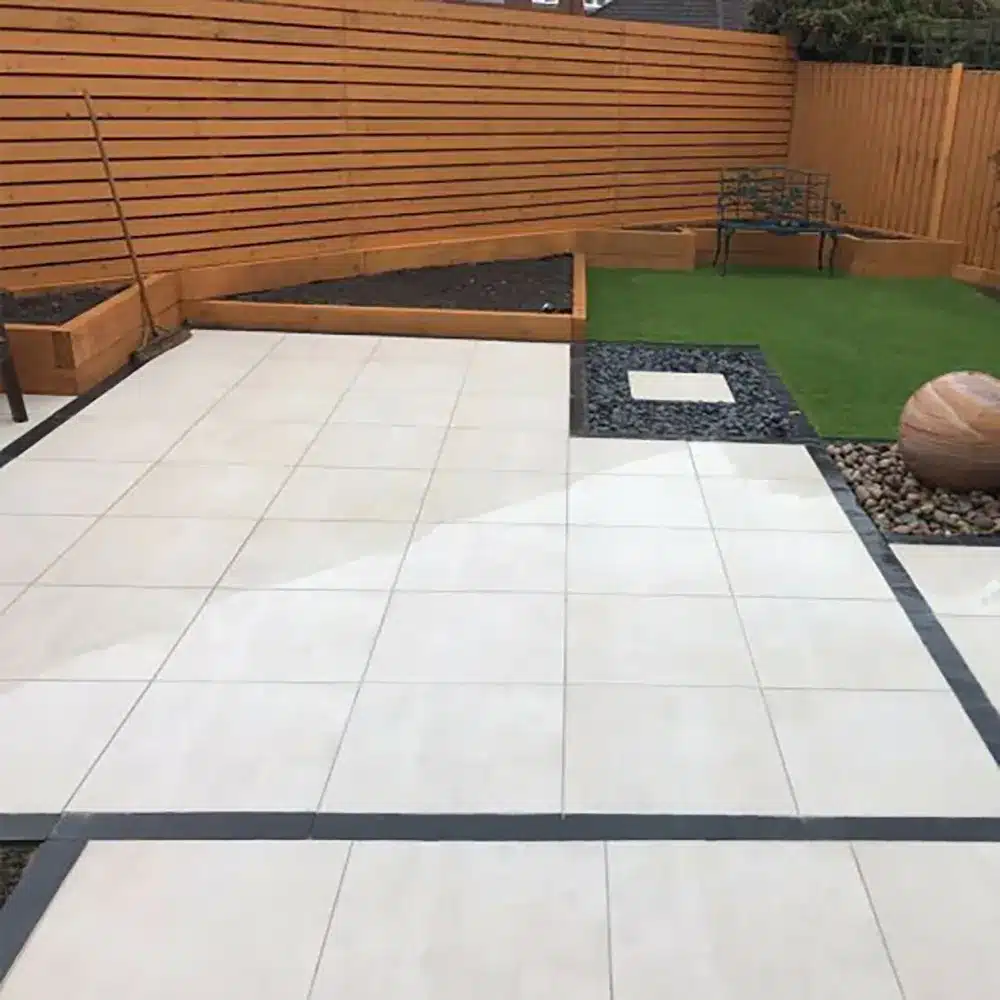
Pale porcelain patio with dark borders beside timber fencing and a lawn

01 / Colour & contrast

A light patio with contrasting borders

Pale paving, timber fencing and dark border details create distinct areas within this garden.

Explore the design details

What to consider for your patio

Compare the main paving and border colours together. A contrasting edge changes the appearance of the whole layout, so include it in the sample shortlist.
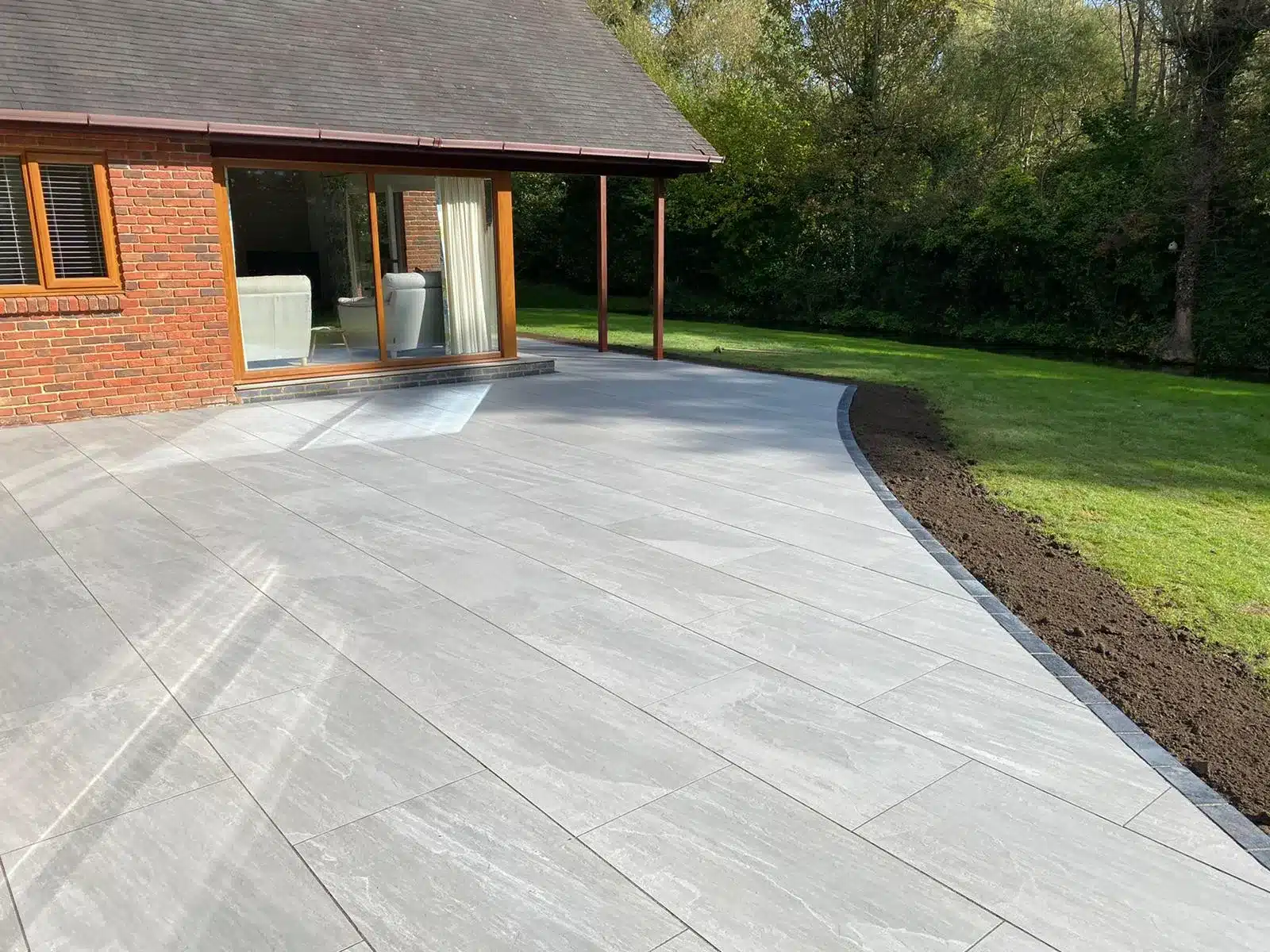
Grey porcelain patio beside a brick garden room with a lawn beyond

02 / Layout & connection

Grey paving beside a garden room

Grey rectangular paving connects the brick garden room with the surrounding outdoor space.

Explore the design details

What to consider for your patio

Draw the slab pattern from the doorway outwards. Check where joints and cuts meet the building, lawn and patio edges before ordering.

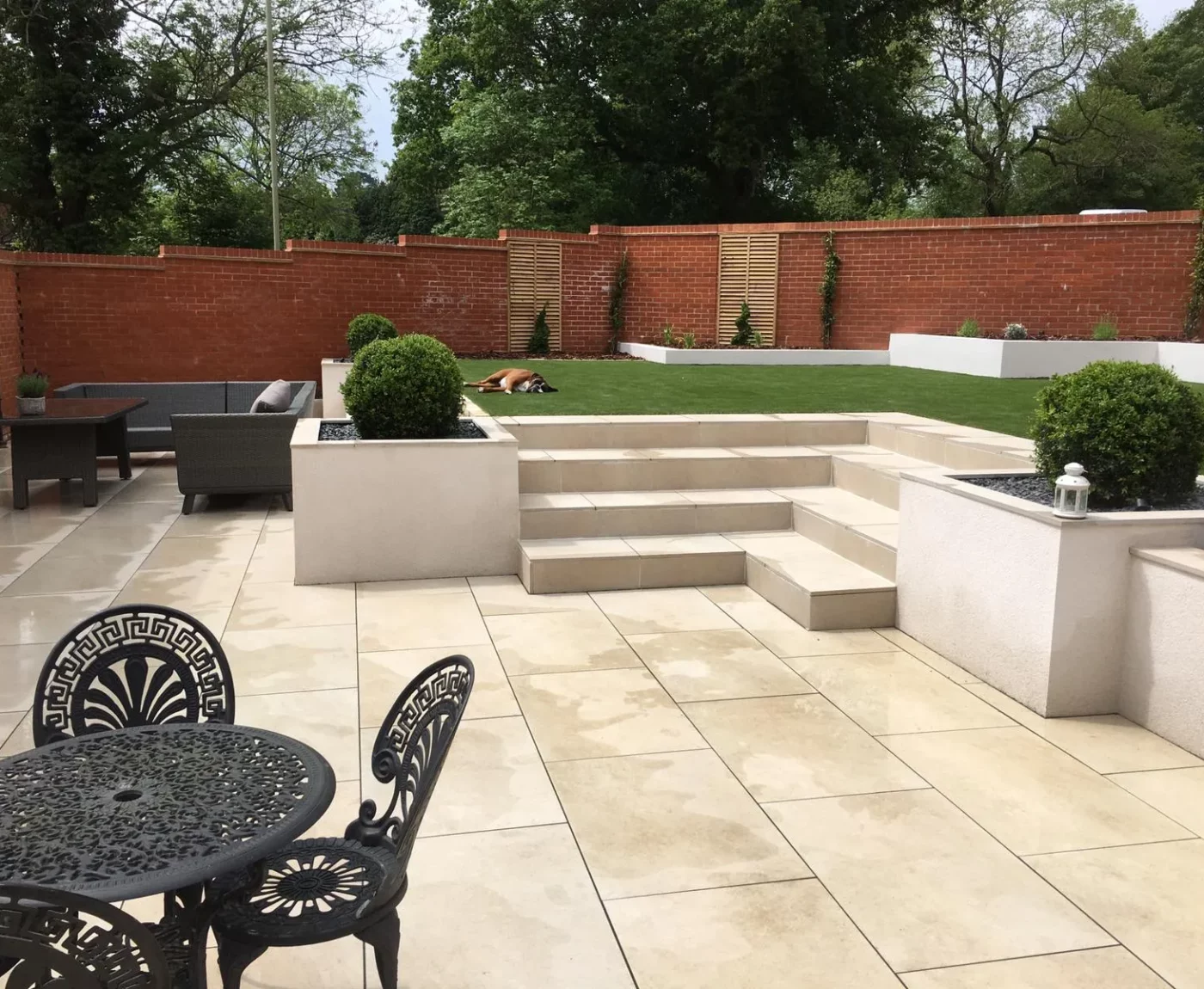
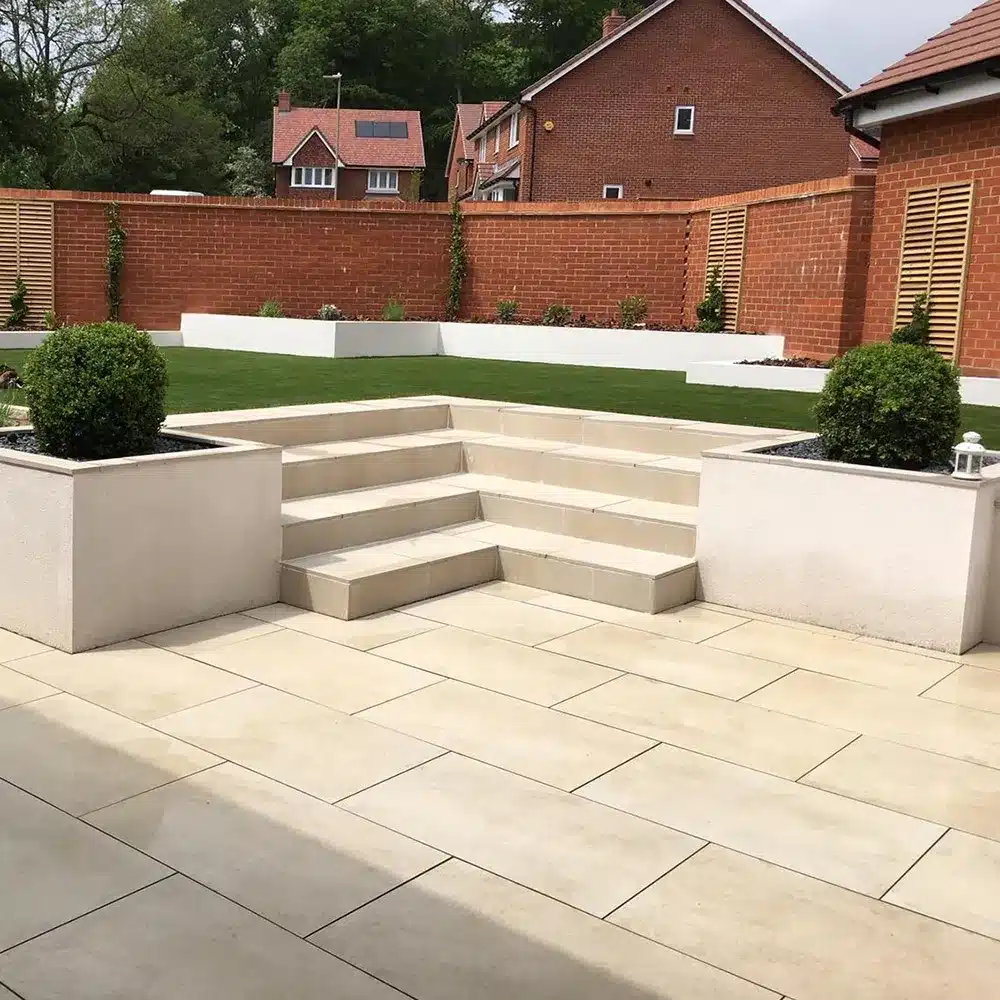
Beige porcelain patio with broad steps leading to a raised lawn between pale retaining walls

03 / Steps & levels

A stepped patio and raised lawn

Broad steps link the lower paved area with a raised lawn, framed by pale retaining walls.

Explore the design details

What to consider for your patio

Treat steps, edges and level changes as part of the initial design. They affect quantities, finishing pieces and the installation budget.

Planning a similar patio? Bring your measurements and ideas to our team.

Discuss your project

05 / Size & layout

Which porcelain paving size should you buy?

Choose the format around the measured space, not a rule that small gardens require small tiles. Sketch the patio in both directions and mark doors, drains, steps and planting beds. This makes awkward cuts easier to spot before you order.

Common formats and what to compare
Format Buying consideration
600 × 600mm A square grid; compare how the joints align with the edges of the space.
600 × 900mm A rectangular format; compare orientation and the cuts at each end.
1200 × 600mm A longer rectangle; discuss handling, access and cutting arrangements with the installer.
Mixed sizes Check the pack composition and recommended pattern rather than ordering by a single slab calculation.

Practical planning check: mark the main view from the house and discuss where cuts will fall around doorways, drains and steps. Agree the layout before ordering so that the chosen format works with the finished levels and edges.

Our guide to paving slab sizes and layouts explores this decision in more detail. If you are considering a larger rectangle, compare the current 1200 × 600mm porcelain options.

06 / Project costs

How much should you budget for porcelain paving?

The paving price per square metre is only one part of a finished patio. Use the current price for your chosen product and quantity, then ask your installer for an itemised quotation. Site access, excavation, disposal, drainage, cuts and steps can change the total substantially.

Think through the installation before comparing totals: ask how the quotation deals with access, excavation, drainage, finished levels and making good around the patio. Resolving these details early gives you a more useful budget.

Compare the same scope across quotations. A labour-only figure cannot be compared directly with a quotation that includes excavation, materials and waste removal.

What to include in your patio budget
Cost Check before ordering
Paving Total quantity including cuts, pack rounding and any spare slabs; confirm VAT.
Delivery Your full postcode, service, access and any split-pack charges.
Groundworks Removal of the old surface, excavation, disposal and base preparation.
Installation materials Bedding, compatible primer, jointing materials and drainage.
Labour and equipment Laying, cutting, handling, tool hire and site access.
Finishing details Edging, steps, covers, transitions and final clean.

A transparent materials example

For illustration, a 25m² patio with a 10% allowance gives a target of 27.5m². At an assumed £30/m² including VAT, the paving calculation is 27.5 × £30 = £825, before rounding to the available slabs or packs. This is an example, not a current product price or an installed quotation.

Use the current porcelain range prices for your own calculation. For a tailored materials order, contact our team with the dimensions, chosen product and delivery postcode.

07 / Below the surface

Excavation depth and the layers beneath your patio

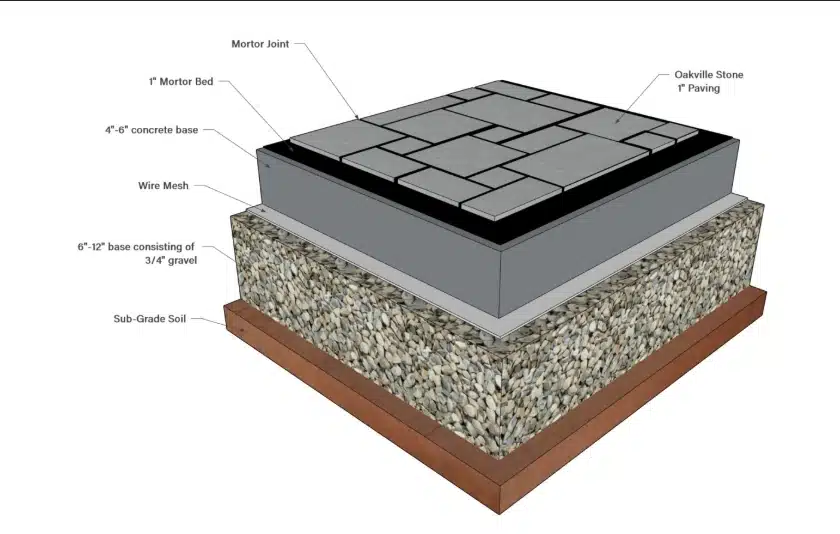
Before ordering, agree the finished patio height and construction with your installer. A conventional mortar-bed patio needs room for the slab, bedding and compacted sub-base. These hidden layers affect the quantity of materials, excavation and waste removal in your quotation.

Cutaway of natural stone paving showing mortar, a reinforced concrete base, gravel sub-base and subgrade soil.
Construction reference. This illustration shows natural stone paving over a reinforced concrete base, with dimensions in inches. The 160mm porcelain patio example below uses a different build-up. View the illustration at full size.
Inside a porcelain patio: an illustrative 160mm build-up

Pedestrian patio on suitable ground • Full mortar-bed example • Diagram not to scale

1. Porcelain paving — 20mm in this example

The finished walking surface; joints follow the product specification.

2. Compatible slurry primer

Bonding coat on the slab underside; shown enlarged for clarity.

3. Full mortar bed — 40mm in this example

Continuous support beneath the slab, without isolated mortar spots.

4. Compacted MOT Type 1 sub-base — 100mm in this example

Suitable graded aggregate, compacted in layers.

5. Separation geotextile — where specified

The installer decides whether the ground needs separation.

6. Prepared, suitable subgrade

The ground supporting the construction; its condition determines the design.

Depth example: 20mm paving + 40mm mortar + 100mm compacted sub-base = 160mm. The primer is a coating, not a separate load-bearing bed.

How deep should you excavate?

In the example above, the formation is approximately 160mm below the proposed finished paving level. This is not automatically 160mm below today’s lawn: the existing and proposed heights may differ. Remove unsuitable material and have the installer confirm that the exposed ground can support the patio. Weak, filled or wet ground may require a different depth or design.

Manufacturer details vary. Marshalls illustrates a 30–40mm mortar bed with a 100mm sub-base for its specified porcelain ranges; Pavestone describes a 40mm minimum bed and 100mm minimum compacted sub-base. Use the instructions for your chosen paving and the site assessment, rather than treating one diagram as a universal specification.

Finished levels, drainage and waste removal

For conventional detailing beside a building, allow at least 150mm below the damp-proof course. Door thresholds and accessible transitions need their own agreed detail. Plan a fall to a suitable drainage destination; Pavestone gives approximately 15mm per metre as an example. Across 4m, that would mean a 60mm change in level. Your installer must confirm the appropriate falls for your project.

Budget example: excavating 25m² to an average 0.16m depth removes 4m³ in place. Loose excavated material takes up more space, so that is not a skip-size recommendation. Ask for disposal, access and any extra groundwork to be included in the quote.

Depth references: Marshalls porcelain installation guidance (PDF) and Pavestone porcelain installation guidance. For the laying sequence, continue to our paving installation guide.

08 / Getting quantities right

How much porcelain paving do you need?

  1. Measure the finished area. For a rectangle, multiply length by width in metres. Break an irregular patio into smaller shapes and add their areas.
  2. Agree the layout. Include steps, borders and separate areas in the plan. Ask the installer to review narrow cuts and complex edges.
  3. Add a suitable allowance. Around 10% is a common starting point for cuts and wastage; intricate layouts may need more.
  4. Convert the target to the available order options. Check the product’s pack coverage, slab quantities and ordering calculator.

Worked example: 25m² using 600 × 900mm slabs

  • Measured patio: 5m × 5m = 25m².
  • With 10% allowance: 25 × 1.10 = 27.5m².
  • Nominal slab face area: 0.6 × 0.9 = 0.54m².
  • Illustrative slab count: 27.5 ÷ 0.54 = 50.93, rounded up to 51 slabs.

Those 51 nominal slabs total 27.54m² before joints. Actual dimensions and advertised coverage may differ, and full-pack ordering may require a different quantity. Confirm the final layout and order with your installer and supplier. Avoid adding the same waste allowance twice if a calculator already includes it.

Ask about split-pack options if a full pack leaves too much surplus. Compare the total delivered cost and preparation time, not just the headline price per square metre. Consider keeping a few suitable spares from the same batch for future repairs.

09 / Plan your paving order

How to use our paving calculator

Our calculator is on the product page, beneath Choose how you’d like to order. It uses the ordering options for that particular paving, so start with your chosen product.

Calculator example

Order by m²

Kandla Grey porcelain · 600 × 900mm

1. Enter your measured area25 m²5m long × 5m wide
ON

2. Include 10% for cuts and wastage

Adds 2.5m² to your measured area

3. Check your order quantity

27.50m² total
51slabs

For this product and example quantity

Illustration of the ordering steps. Use the product calculator below for current options and prices.
  1. Measure your patio in metres. Multiply length by width. A 5m × 5m patio is 25m²; add together separate areas where necessary.
  2. Choose your ordering option. Compare the full pack and smaller packs shown, or use Order by m² where available. Pack sizes and options vary by product.
  3. Enter your measured area. For this example, enter 25 in the Square metres box. Leave other pack quantities at zero when trying the per-m² option on its own.
  4. Select the cuts and wastage allowance. Switch on Include the recommended 10% for cuts and wastage if that allowance suits your layout. Discuss complex cuts with your installer.
  5. Review the result. In our Kandla Grey 600 × 900mm example, 25m² with the allowance gives 27.50m² total and 51 slabs. Check the current price, quantity and available pack alternatives before adding your selection to the basket.

Example: 25m² measured area + 2.5m² allowance = 27.5m² to order. If you enter 27.5m² because you have already included the allowance, leave the 10% switch off.

The calculator prices your paving selection. Budget separately for excavation, bedding, primer, jointing, labour and other installation costs. Confirm delivery charges and services for your postcode at checkout.

Try the Kandla Grey paving calculator

Prefer another colour or size? Choose your porcelain paving and use the calculator on its product page. You can also read our ordering guide.

10 / Your order

Check the order and delivery before booking work

Order the main project quantity together where possible. Before paying, confirm the product, finish, dimensions, quantities, batch arrangements and current stock. Keep the order confirmation so you can compare it with the delivery.

Paving arrives on heavy pallets. Check the delivery information and access requirements, including the unloading surface and vehicle access. Standard delivery is kerbside; placement in a garden or on a driveway is not guaranteed. Tell the team about slopes, gravel, narrow roads or other restrictions before ordering.

Check the charge for your full postcode and allow for preparation time on split packs. Delivery estimates are not guaranteed dates. Wait until the paving has arrived and been checked before committing to your installer’s start date.

We thoroughly check all our paving products before dispatch. On arrival, inspect quantities, labels, visible damage and appearance before laying. Photograph any concerns and contact the store promptly under the applicable delivery and returns terms. Keep affected slabs unlaid while a concern is resolved.

11 / A lasting finish

Plan installation and everyday care

Agree the construction with a competent installer before buying. For the mortar-bed approach covered in our paving installation guide, porcelain needs appropriate preparation, full support and compatible bonding materials. Plan drainage, finished levels, joints and thresholds as part of the same job.

Check primer and bonding products against the slab and bedding instructions. For cutting equipment and preparation, use our porcelain cutting guide. Cutting and fitting costs belong in the budget even when the paving itself looks straightforward.

Porcelain is low maintenance, rather than maintenance free. Sweep away leaves and soil, clean spills, and use cleaning products compatible with the paving and joints. Follow the manufacturer’s aftercare instructions and test a cleaner in a discreet area first. Porcelain usually does not require sealing; check the exact finish before applying any treatment.

12 / Your questions

Porcelain paving buying questions

Is 20mm porcelain always suitable outdoors?

Thickness alone is not enough. Confirm that the exact slab is intended for the location and installation system. Vehicle loads, raised systems and heavy features need specific advice.

Is R11 porcelain completely non-slip?

No. R11 describes a test result. The finish, contamination, drainage, maintenance and intended use all matter. Ask for appropriate slip-performance information for your project.

Can a small garden use large porcelain slabs?

Yes, if the layout works. Draw the pattern against the actual boundaries and compare edge cuts before choosing. Include handling and installation requirements in the decision.

How much extra porcelain paving should I buy?

Start by discussing around 10% for cuts and wastage with your installer. The right allowance depends on the pattern, patio shape and cuts. Then round to the available slab or pack options.

Can I order more from the same batch later?

Do not rely on it. Stock and production batches change. Plan the complete requirement together and ask about spare slabs before the original order is dispatched.

How can Natural Paving Store help me choose?

Alongside product advice, we have the practical knowledge of our sister company, Natural Paving Installations, and its 30 years of professional patio and paving installation experience. Talk to us about your paving shortlist, layout and quantity questions. For site-specific construction advice, your installer needs to assess the garden and agree the specification.

The next step

Let’s plan your patio.

Shortlist your finish, check sample availability, and agree the measured layout with your installer. Then compare the delivered order for your chosen porcelain paving. Our team can help with product and quantity questions on 01329 238150.

Talk to our paving team