Indian Sandstone Paving Buying Guide

17 Nov 2026

Paving

Camel Buff Sandstone paving slabs 100x100mm sample

Indian sandstone paving brings colour, texture and a sense of permanence to a garden. This buying guide takes you from the first sample to a finished patio: compare colours and finishes, choose a practical slab size, understand excavation and laying, and plan for straightforward cleaning and care.

Start with the whole project. A beautiful slab still needs the right layout, drainage and installation. Our advice is backed by the 30 years of practical paving experience behind our sister company, Natural Paving Installations.

01 / The appeal of real stone

Is Indian sandstone paving right for your patio?

Choose Indian sandstone when you want an individual surface: tonal changes between slabs, natural markings and a finish that sits comfortably beside brick, timber and planting. It is especially appealing in courtyard, cottage and English country gardens, but a restrained grey or sawn finish can also work with a contemporary house.

The trade-off is that real stone varies and needs sensible care. A colour name is not a promise that every slab will look the same. Texture, porosity and surface finish also differ between products, so compare the actual stone you intend to buy.

  • For natural character: shortlist riven sandstone and mixed-size packs.
  • For a more ordered look: compare rectangular slabs, sawn edges and a quieter joint colour.
  • For easier day-to-day cleaning: consider the amount of shade, nearby trees and how much maintenance you are comfortable with.
  • For a decision beyond sandstone: read our natural paving buying guide or porcelain versus natural stone comparison.

Browse Indian sandstone paving →

02 / Design with the setting

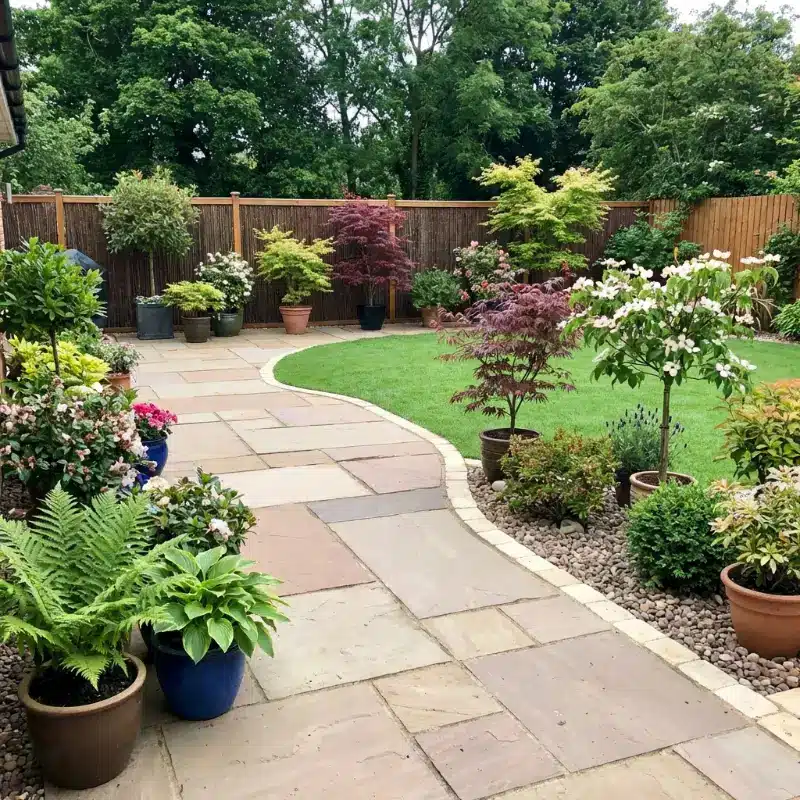
Sandstone in courtyard, country and cottage gardens

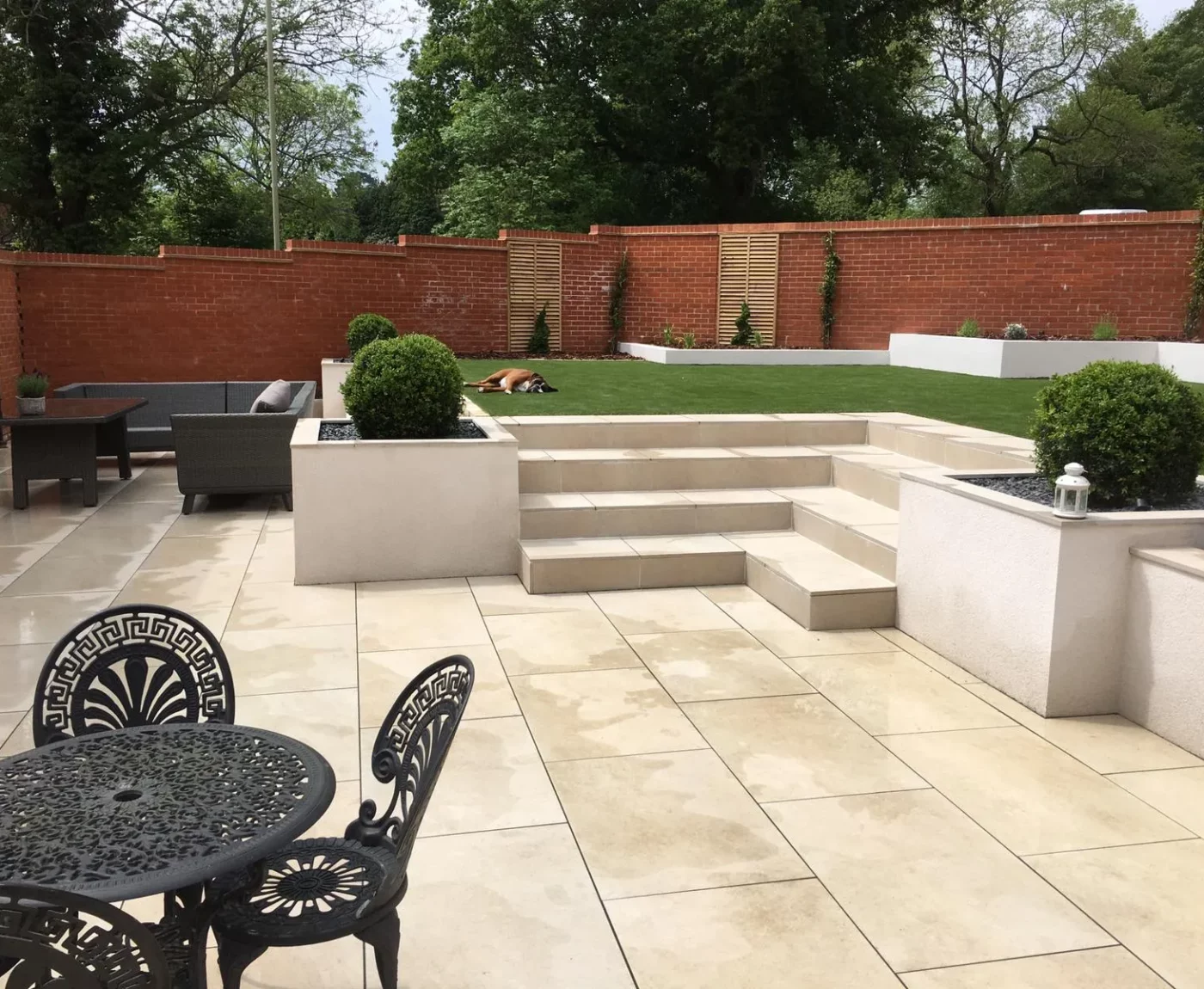
These photographs from our own website show ways to use natural stone, planting and edging together. Use them as design inspiration, then adapt the layout, colour and details to your own garden.

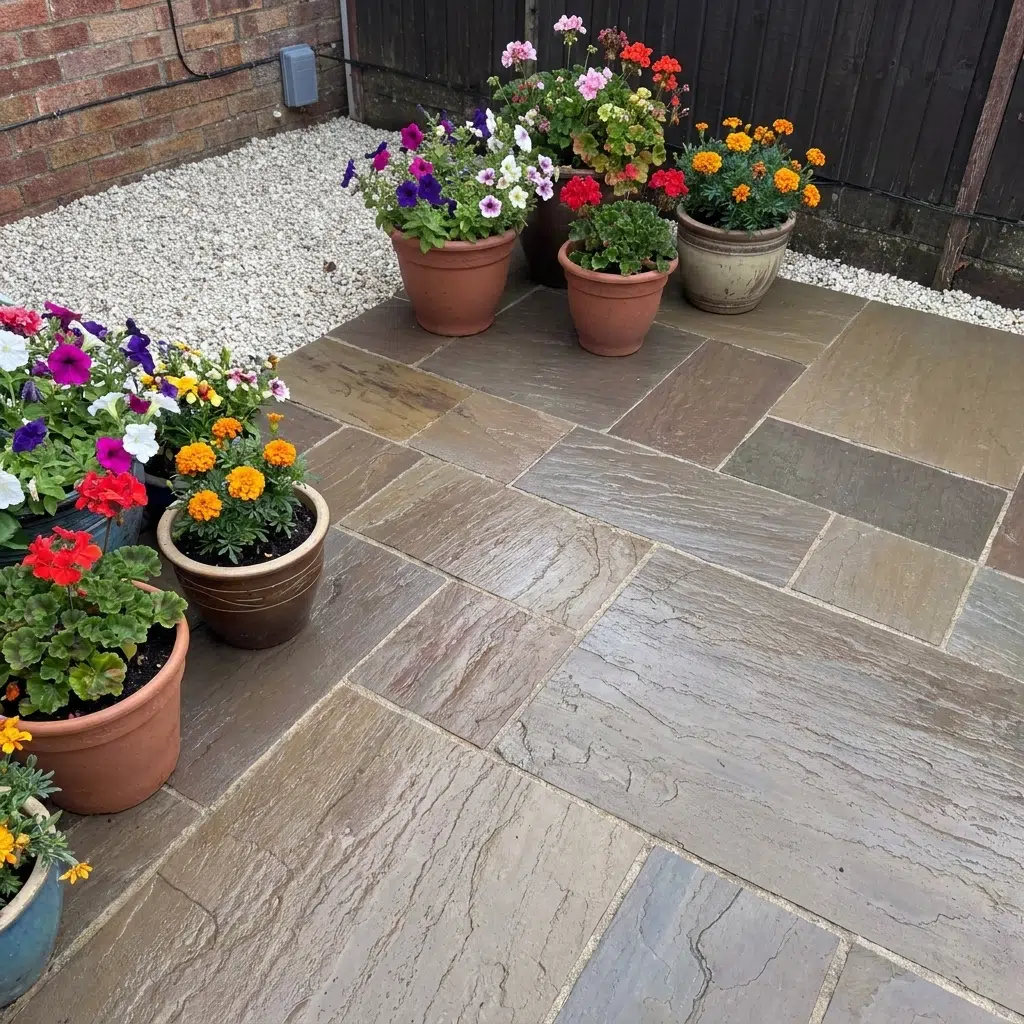
Varied Raj Green sandstone paving beside brickwork and terracotta pots of flowers

01 · Courtyard gardens

A calm courtyard with natural texture

In a small enclosed garden, choose the stone against the walls first. Warm sandstone can soften a brick courtyard; a cooler grey can sit well beside pale render and dark window frames.

Explore the design details

Mark the table, chairs and walking route on the ground before choosing slab sizes. Large rectangles can work in a small courtyard when the cuts are well planned; small paving is not automatically the better choice.

Keep the number of materials restrained. A simple paved field, planted border and a few generous pots often give a courtyard more cohesion than several competing patterns.

Compare a dry sample with a damp one in the shaded parts of the garden, then browse our sandstone range.
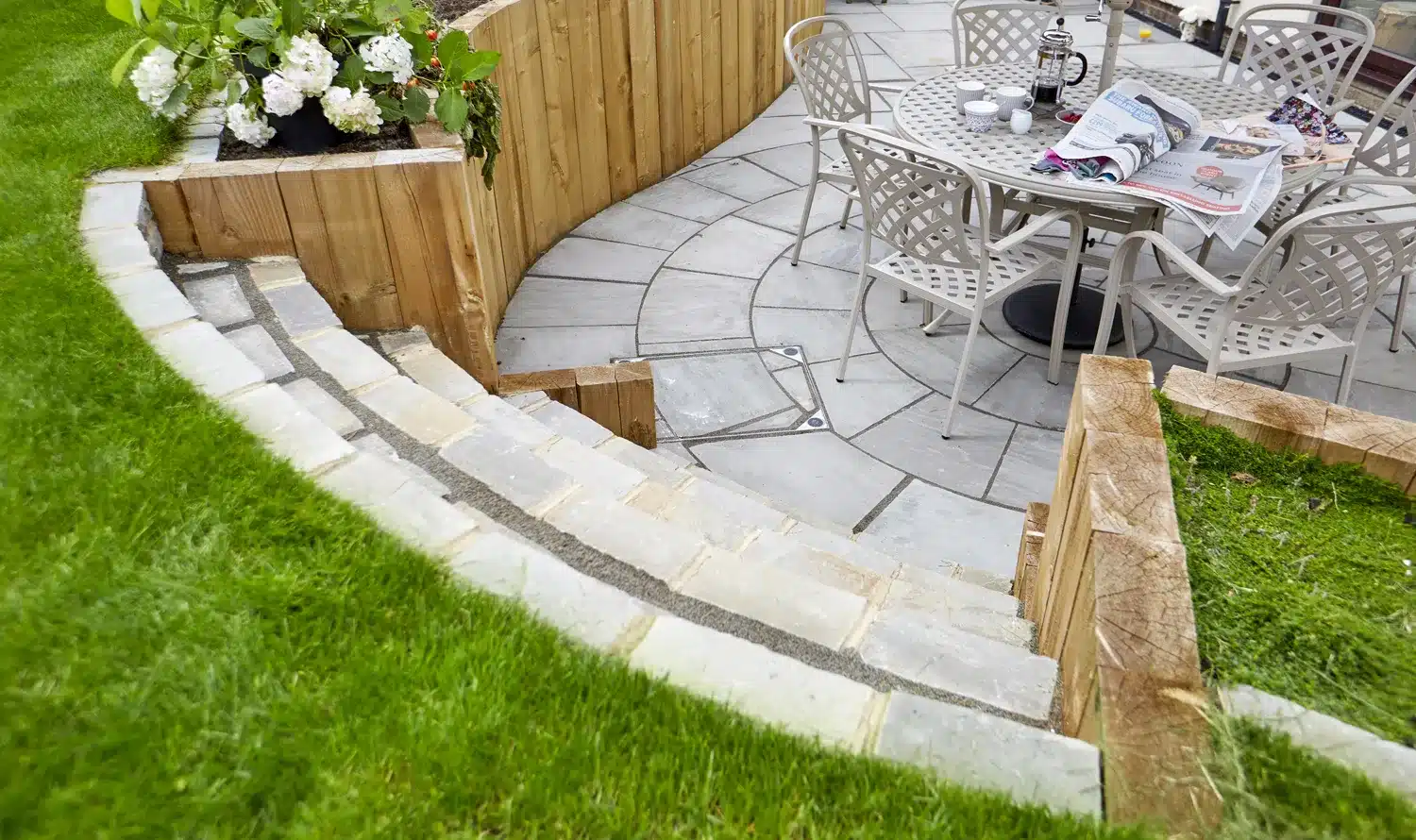
Natural stone circular seating area with garden furniture, timber edges and flowering planting

02 · English country gardens

A terrace that connects to the garden

Earthy sandstone colours can carry the warmth of a house into deep borders and a lawn. A mixed-size terrace or curved seating area gives room for planting to soften the edge.

Explore the design details

Plan the usable seating area with chairs pulled out. A decorative circle should be large enough for the furniture as well as attractive from the house.

Repeat one edging material along paths to connect separate spaces. Check how the chosen pattern meets curves before ordering: extra cutting and border pieces affect the quantity.

Explore paving circles and sandstone setts.

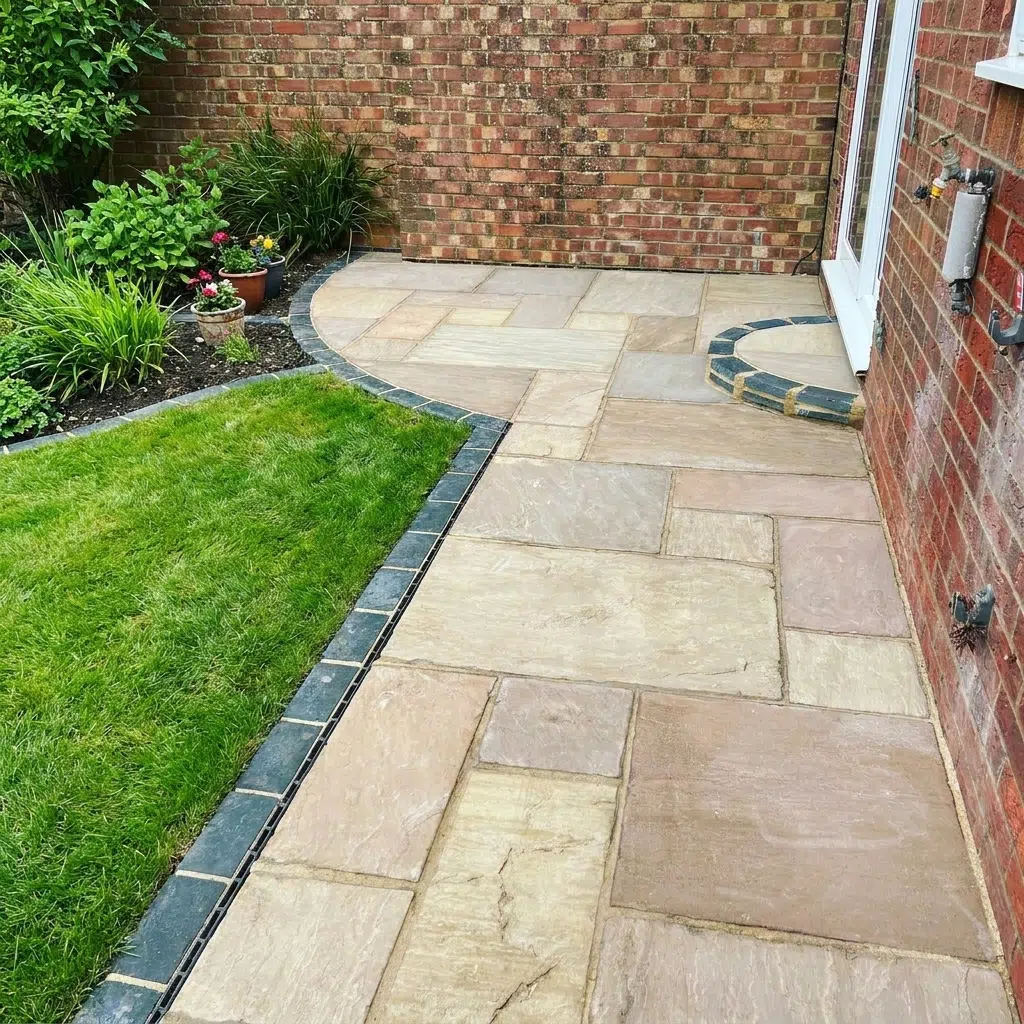
Mixed-size sandstone patio with a curved dark sett edge beside a red brick house and lawn

03 · Cottage & old English-style gardens

A settled look beside older brickwork

Riven texture, handcut edges and warm colour variation can suit cottage and old English-style gardens. Let the building and planting set the palette before adding decorative details.

Explore the design details

Raj Green is a useful starting point beside varied brickwork because it brings several earthy tones into one surface. The right choice still depends on your particular house and the spread of colour across the batch.

Choose a joint colour that complements the stone. A strongly contrasting joint emphasises every slab; a quieter tone lets the terrace read as a whole.

Compare Raj Green sandstone and view samples in the garden before deciding.

Choose in the setting that matters. Put samples beside your walls, doors and planting, then view them wet and dry.

Compare natural stone samples

03 / Build your shortlist

Which Indian sandstone colour should you choose?

Start with the permanent colours around the patio: brick, render, roof tiles and window frames. Choose two or three sandstone ranges that work with those materials, then compare samples outdoors. Our suggestions below are a starting point, not a rule for how a garden must look.

Colour family Where to start What to compare at home
Kandla Grey A cooler grey palette for simple planting schemes, pale walls or dark frames. How lighter and darker pieces sit beside the house; natural grey is not a uniform print.
Raj Green An earthy mixture for brick houses, cottage gardens and traditional terraces. The full spread of grey-green, brown and buff; the name does not mean a solid green patio.
Camel Buff A warmer sandy palette for brick, timber and abundant planting. Whether the warmth complements the wall rather than competing with it.
Fossil Mint A lighter cream and buff direction with individual natural markings. The variation across several pieces and how marks show in your intended location.
Autumn Brown A deeper, warmer palette for rustic surroundings. Its appearance in shade and alongside your chosen joint colour.

Look at the stone wet and dry

Wet sandstone usually looks darker and its markings become more prominent. View samples in daylight, shade and after wetting them with clean water. A small sample shows texture and an individual tone, while photographs of a larger area help you judge the likely variation.

Ask to see the current product photographs and specification. Blend slabs from different packs during laying so the patio has an even spread of colour rather than separate light and dark patches.

For more ranges, including Rippon Buff, Raj Blend, Ivory Mint and Raveena, use our Indian sandstone colours and finishes guide.

04 / Look closer

Riven, sawn, honed and calibrated sandstone explained

Colour is only one part of the decision. The face, edges and underside of a slab affect its appearance and the work needed to install it.

  • Riven: a naturally split face with surface variation. It gives a textured appearance suited to relaxed and traditional settings.
  • Sawn edges: a straighter outline for a more regular layout. Check the face finish separately; a sawn edge does not tell you everything about the surface.
  • Honed: a smoother, refined face. Ask about the product’s outdoor suitability and slip performance for the location.
  • Calibrated: the underside is processed towards a stated thickness, helping the installer manage the bedding. It does not remove natural variation from the face or make the slab perfectly identical.

What thickness do you need?

Our linked Raj Green example is specified at 22mm, but thickness must be checked on the exact product. Do not assume all sandstone ranges have the same tolerance or are suitable for the same loads. A pedestrian patio specification should not be reused for a driveway, hot tub base or other heavily loaded area.

Ask your installer to confirm the paving, bedding and foundation as one system. A thicker slab alone cannot compensate for poor support or weak ground.

Choose natural stone samples →

05 / Proportion & detail

600 × 900, 600 × 600 or mixed-size patio packs?

Choose the format with a drawing of the actual space. The best slab size is the one that produces a balanced layout, useful seating space and sensible cuts around doors, edges and drains.

Format Design effect Check before buying
600 × 900mm rectangles Longer lines and a regular rhythm; useful for both traditional and modern layouts. Set out the pattern in both directions. Avoid narrow cut strips against the house or at the far edge.
600 × 600mm squares A balanced grid that can suit compact terraces and repeated spaces. Confirm the exact sandstone colour and finish is offered in this size; the available range differs by product.
Mixed-size patio packs A less uniform pattern that often suits country and cottage gardens. Use the supplied size quantities and a workable laying plan. The pack does not contain unlimited pieces of every size.

Do large slabs work in a small garden?

They can. A small courtyard with a simple boundary may take rectangles very neatly, while a narrow winding path may need more cuts. Tape out a few slab outlines at full size and test the furniture arrangement. Judge proportion and cutting waste together rather than applying a fixed rule based only on garden area.

Plan joints, borders and changes in level

Joint widths depend on the stone edges and the chosen jointing product. Confirm whether quoted sizes and coverage include the joint allowance. Dry-lay a representative panel before committing to the pattern, especially for mixed packs.

Setts can resolve a curved border; steps need their own detail and quantities. Ask how the layout meets inspection covers and door thresholds before calculating the order.

For wider comparisons across materials, read our paving slab size guide.

06 / Price the whole project

Indian sandstone paving costs: plan the whole patio

Compare complete quotes, not just a headline price per square metre. The stone, format and finish affect the purchase price, while ground conditions, access and detailing can make a substantial difference to installation work.

  • Paving: the specified colour, finish, thickness, order quantity and cutting allowance.
  • Preparation: removal of old surfaces, excavation, disposal and suitable sub-base.
  • Installation materials: bedding, bonding primer, jointing and edge restraints.
  • Details: drainage, steps, borders, covers and threshold work.
  • Logistics: delivery, access, storage and moving materials to the garden.
  • Finishing and aftercare: any agreed sealing, cleaning and maintenance instructions.

Ask each installer to describe the proposed build-up and drainage so the quotations cover comparable work. Use the current product page for the paving price and pack options, then confirm delivery and labour separately. We avoid a single installed-price promise because it can hide the work your site actually needs.

07 / What lies underneath

How deep should you excavate for sandstone paving?

Work down from the proposed finished surface. Excavation must make room for the slab, finished mortar bed and compacted sub-base, while removing unsuitable ground. Agree drainage and levels before digging; existing ground height alone is not the design level.

A conventional mortared patio: the layers to discuss

Concept diagram, not to scale. Your installer must specify the materials and dimensions for the site and paving.

1 · Sandstone paving

The actual product thickness, with suitable joints.
2 · Compatible bonding primer

Applied as required by the paving and bedding system.
3 · Full supporting mortar bed

Continuous support beneath each slab, rather than isolated spots.
4 · Compacted sub-base

Suitable graded material, built and compacted in layers.
5 · Separation where specified

A suitable geotextile only where the ground design requires it.
6 · Prepared formation

Stable ground at the agreed excavation level.

Illustrative depth calculation: 22mm paving + an assumed 40mm finished bedding layer + 100mm compacted sub-base = 162mm below the proposed finished surface. This is arithmetic to show the method, not a specification for your garden; weak ground or different loads can require a different build-up.

Read the depth example correctly

The 162mm example measures down from the new finished paving surface. It is not an instruction to remove 162mm everywhere from the existing lawn. Slopes, soft spots and changes in level can alter excavation and disposal volumes.

A 100mm compacted sub-base is used in some manufacturer guidance for suitable pedestrian patios. It is not a universal minimum for every ground condition. Your installer should assess weak or made ground, drainage and loads before specifying the depth and any geotextile.

Set drainage before laying

Provide a fall towards a suitable drainage destination and away from vulnerable building details. As a calculation example, a 1:60 fall drops about 16.7mm per metre, or 50mm over 3m. That illustrates the maths; the installer must select the appropriate fall for the surface and site rather than applying one figure to every patio.

Conventional paving is generally kept at least 150mm below a building’s damp-proof course. Accessible thresholds need a properly designed detail. Do not cover air bricks, trap water against walls or assume that absorbent stone makes a mortared patio permeable.

Compare the principles in Marshalls’ sandstone laying guidance and our paving installation guide, then agree the actual site specification with your installer.

08 / From plan to patio

How to lay Indian sandstone paving

This sequence explains a conventional full-mortar-bed pedestrian patio so you can discuss the work confidently. The selected stone, mortar, primer and jointing instructions determine the final specification.

  1. Inspect and set out. Confirm the stone, quantities and colour spread before laying. Mark boundaries, finished levels, drainage and the pattern; identify underground services before excavation.
  2. Excavate and prepare the formation. Remove unsuitable material and resolve soft areas. Check the agreed levels before covering the ground.
  3. Build the sub-base. Place suitable graded material and compact it in layers to the specified finished depth. Establish stable edges and the planned profile.
  4. Prepare the slabs and bed. Remove dust from the underside as directed. Use the mortar specified for the system and create continuous support beneath each slab; avoid isolated mortar spots.
  5. Apply a compatible bonding primer. Coat the underside as the manufacturer instructs and place onto the fresh bed within the working time. Keep primer and mortar off the face.
  6. Lay, blend and check. Select slabs across the packs, tap into position with suitable tools and repeatedly check alignment, falls, joints and full support. Correct rocking or poor levels while the bed remains workable.
  7. Cut and finish details carefully. Use suitable equipment and dust controls, protect neighbouring surfaces and clean as you work. Plan safe handling for heavy slabs.
  8. Joint, cure and hand over. Use a compatible jointing system at its specified joint width and depth. Follow its weather, drainage and curing requirements before use. Obtain care instructions for the stone and joints.

Three details worth discussing with your installer

Full support: spot bedding leaves voids and can lead to movement or staining. Compatibility: the jointing product must suit the stone and construction. Clean working: dried cement and primer marks are much harder to address than preventing contamination during laying.

For cutting with a cut-off saw, HSE advises effective dust suppression or suitable extraction plus appropriate respiratory protection; tight-fitting masks require face-fit testing. See the HSE guidance on cutting paving.

Further detail: our step-by-step installation guide and Pavestone’s natural stone installation guidance. Bedding mixes, joint dimensions and curing periods vary by system, so use the instructions for the materials supplied.

09 / Measure with the layout

How much sandstone paving should you order?

Measure in metres and multiply length by width for a rectangle. Split an irregular patio into simpler shapes and add their areas, avoiding overlaps. Measure borders, steps and separate paths explicitly rather than assuming they are covered by the main patio figure.

Example: a 5m × 5m patio measures 25m². Adding a 10% cutting allowance gives 27.50m². Ten per cent is a useful starting point for many straightforward layouts, but curves, diagonal patterns and complicated cuts may need more. Agree the allowance against the laying plan.

For 600 × 900mm rectangles, the nominal face area is 0.54m². Dividing 27.50 by 0.54 gives just over 50.9, rounded up to 51 slabs for the illustration below. Actual ordering must follow the product’s stated coverage, joints and available pack options.

With a mixed-size pack, check the supplied pattern and number of each size. Area alone cannot prove that you have enough of a particular piece to finish the design. Ask about split-pack options if the standard pack does not match the project.

10 / Turn measurements into an order

Use our sandstone paving calculator before ordering

Each product has its own pack options and quantity controls. This example uses our Raj Green 22mm sandstone in 600 × 900mm. It shows the calculation process; open the product page for its current specification, availability and total.

Worked example · 5m × 5m patio

Order by m²

Raj Green sandstone · 600 × 900mm

Square metres entered25 m²
ON

Include the recommended 10% for cuts and wastage

Enter the measured area first. Do not add the same allowance twice.

Example displayed result

27.50m²Including the selected allowance
51Slabs shown for this example

Slab quantities and pack combinations depend on the selected product.

Illustration of the product calculator, checked on this product. This panel is a worked example; use the linked product page to calculate your own order.

Follow these four steps

  1. Open the exact product. Check size, thickness, finish and the available full or smaller packs.
  2. Enter your measured area under “Order by m²”. For this example, enter 25. Alternatively, compare the offered pack quantities.
  3. Choose your cutting allowance once. Switch on the 10% option if it matches the allowance agreed for your layout. If your entered quantity already includes that allowance, leave it off.
  4. Review the displayed total and slab quantity. Compare with the laying plan and pack information before ordering. Ask our team about a mixed-size layout or a different required allowance.

Open the Raj Green product calculator →

The calculator helps translate measurements into a product quantity. It does not assess ground conditions or design the laying pattern.

11 / Before the paving arrives

Check the order, delivery access and stone before laying

Order the whole project together where possible and confirm the exact product, thickness, finish, pack coverage and delivery arrangements. Keep the laying plan and order confirmation available when the paving arrives.

  • Before delivery: check vehicle access, unloading arrangements and the available hard, level receiving area with our team. Tell us about restricted roads or difficult access.
  • On arrival: check the product and quantities, photograph any visible issues and follow the delivery and claims procedure.
  • Before laying: inspect the slabs and spread out a representative selection to check colour and texture. Keep any disputed pieces unlaid while the issue is resolved.
  • During installation: blend across packs and retain useful spare pieces for later repairs.

Our paving is thoroughly checked before dispatch. Your delivery inspection is still important because it checks the order after transport. Read our delivery information and waste and damages guidance for the applicable arrangements.

12 / Living with natural stone

How to clean Indian sandstone paving

A little routine care is easier than trying to rescue a patio after months of leaves, algae and spills. Start gently and use a method that suits the Indian sandstone, any sealer and the jointing material.

Routine cleaning: four practical steps

  1. Sweep first. Remove loose dirt and leaves, especially in corners and around pots.
  2. Choose a suitable cleaner. Use a cleaner labelled for your natural sandstone and any existing sealer, following its dilution and safety instructions. Test an inconspicuous area first.
  3. Agitate gently. Work with a suitable non-metal brush, keeping the cleaner within its stated working time and off sensitive adjacent materials.
  4. Rinse as directed. Remove the loosened dirt, manage the run-off and let the stone dry before judging the result.

Algae, black spots, rust and other marks

Identify the mark before choosing a treatment. Organic growth, food stains, cement residue and iron staining need different approaches. For persistent marks, send our team clear photographs and details of the stone, sealer and products already used before applying another chemical.

Use only a treatment specifically suitable for the stone and the problem. Follow precautions for nearby plants, pets and run-off. Never mix cleaning chemicals. Avoid general brick acid, vinegar and improvised acid washes: sandstone can react and develop lasting discolouration.

Can you pressure wash Indian sandstone?

Check both the paving and jointing guidance first. A concentrated jet can damage the surface or dislodge joints. There is no single pressure setting that is safe for every sandstone, machine and nozzle. If the manufacturers permit pressure washing, use their specified method, test first and keep the jet away from vulnerable joints. Do not pressure wash newly installed paving before the system allows it.

Does Indian sandstone need sealing?

Sealing is a product and use decision, not an automatic requirement for every patio. A compatible outdoor impregnating sealer can help reduce absorption and staining, but it does not make a patio maintenance-free or repair drainage problems.

Check whether sealing is recommended for your stone and jointing system, when it can be applied, and whether it changes colour or slip performance. Test a spare slab and compare natural-look and colour-enhancing results before treating the whole patio. The stone must be prepared and dry to the sealer manufacturer’s requirements.

For treatment selection, consult the product manufacturer. LTP’s sandstone care advice explains why the source of a stain matters, while its external stone sealer information illustrates the need for a compatible system.

13 / The finer points

Indian sandstone paving: common buying questions

Is Indian sandstone suitable for UK patios?

It is widely used for pedestrian patios and garden paths. Choose a product specified for the intended use and install it on an appropriate, well-drained construction. Performance depends on the actual stone and installation, not the country name alone.

Which sandstone colour is best for a traditional garden?

Raj Green, warmer buff tones and Autumn Brown are useful starting points beside brick and cottage planting. Compare samples against your house; the best choice is the one that works with the existing materials and the variation you enjoy.

Should I choose 600 × 900mm slabs or a mixed-size pack?

Rectangles give a more regular pattern; mixed packs can create an informal traditional effect. Check a scaled laying plan, the cuts and the pack’s actual size quantities before deciding.

Can sandstone paving go straight onto soil or sand?

This guide covers a conventional full-mortar-bed patio over a suitable compacted sub-base. Do not substitute a loose soil or sand bed without a system specifically designed and approved for the paving and use.

How deep do I need to dig for sandstone paving?

Add the specified slab thickness, finished bedding and compacted sub-base, then account for ground conditions and finished levels. The 22mm + 40mm + 100mm example in this guide totals 162mm below the proposed surface, but is not a specification for every garden.

Will the sandstone look different when wet?

Usually, yes: moisture can deepen the colour and highlight markings. Compare samples wet and dry, and look at a spread of pieces rather than relying on one small sample.

Is sandstone slippery?

Grip depends on the finish, wet conditions, contamination and maintenance. No natural stone should be treated as universally slip-proof. Ask about the product’s tested performance for the location and remove algae and other slippery deposits.

Can I use this sandstone for a driveway or hot tub?

Do not assume pedestrian patio slabs or the illustrative build-up are suitable. Confirm the product, loading, foundation and drainage with an appropriate installer or designer before ordering.

Can I use bleach or acid to clean sandstone?

Do not use improvised chemical mixtures or general acid cleaners. Choose a treatment expressly suitable for the particular sandstone, stain, sealer and joints, follow its instructions and test first. Ask for advice if the mark is unidentified.

Can you help me calculate the order?

Yes. Use the product calculator with your measured area and agreed allowance, then contact our team with the layout if you need help with mixed-size packs, borders, steps or delivery access.

Bring the plan together

Choose your sandstone with confidence

Bring us your shortlist, measurements and layout. We can help you compare the stone, understand the order options and take the next step towards your patio.

Shop Indian sandstone paving →