Natural Stone Paving Buying Guide

17 Nov 2026

Paving

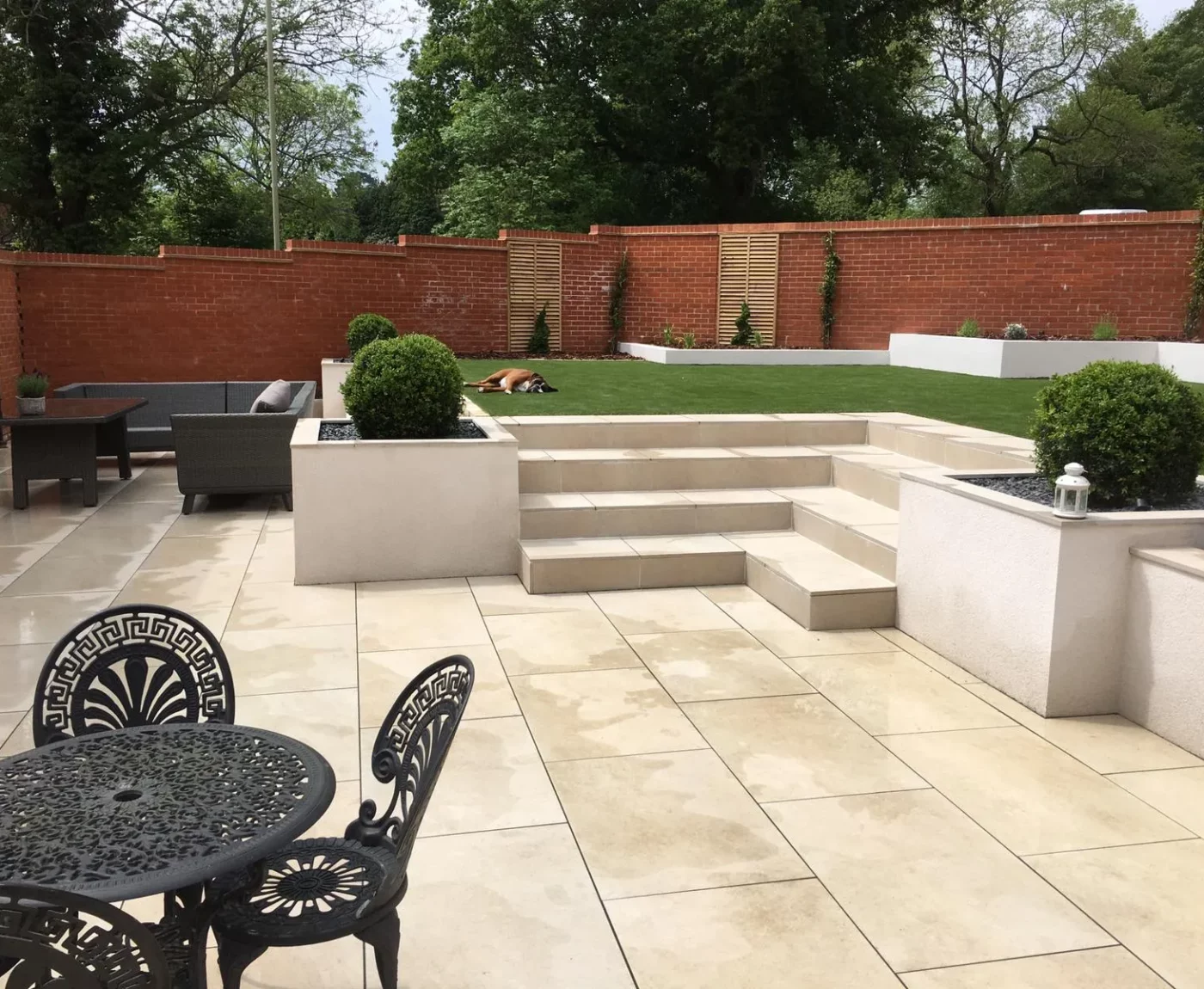
Stone paving circle with outdoor dining furniture and setts at the edge

Natural stone brings individual colour, texture and character to a garden. This natural stone paving buying guide helps you choose a patio that belongs beside your home, from a small courtyard to an English country garden, with practical insight from our sister company, Natural Paving Installations, and its 30 years of professional paving experience.

A garden with character

Start with the house, the planting and how you want to use the space. Then compare stone, finish, layout and upkeep. Explore our natural stone paving range for current products and prices, or order samples to compare at home.

01 / The appeal of real stone

Why choose natural stone paving?

The attraction is the variation: mineral markings, subtle shifts in shade and a surface that feels part of the landscape. When you want paving to sit comfortably beside weathered brick, timber, stone walls and generous planting, these differences can be an advantage.

Natural stone is often a stronger design choice than a very uniform contemporary finish when the aim is an established, relaxed garden. Porcelain can also suit traditional homes; the right choice depends on the particular product and how much variation and upkeep you welcome. Our porcelain versus natural stone comparison explores that decision in more detail.

  1. CharacterChoose a colour blend you enjoy across a whole patio, rather than expecting every slab to match.
  2. Connection to the houseTake cues from brick, render, roof tiles and existing garden walls.
  3. A coherent gardenConsider paths, borders, circles and steps as part of the same design.
  4. Practical suitabilityCheck the exact stone, surface, thickness and construction for the intended use.
  5. Comfort underfootThink about chairs, pushchairs, walking aids and frequently wet routes.
  6. Long-term appearanceChoose stone whose changing colour and maintenance needs suit you.

For more sandstone-specific detail, see our sandstone paving colours, finishes and patio advice.

02 / Design with the setting

Three garden styles where natural stone comes into its own

Use these as design directions, then adapt them to your house and daily routine. The photographs are from our existing paving collection and illustrate colour, texture and detailing.

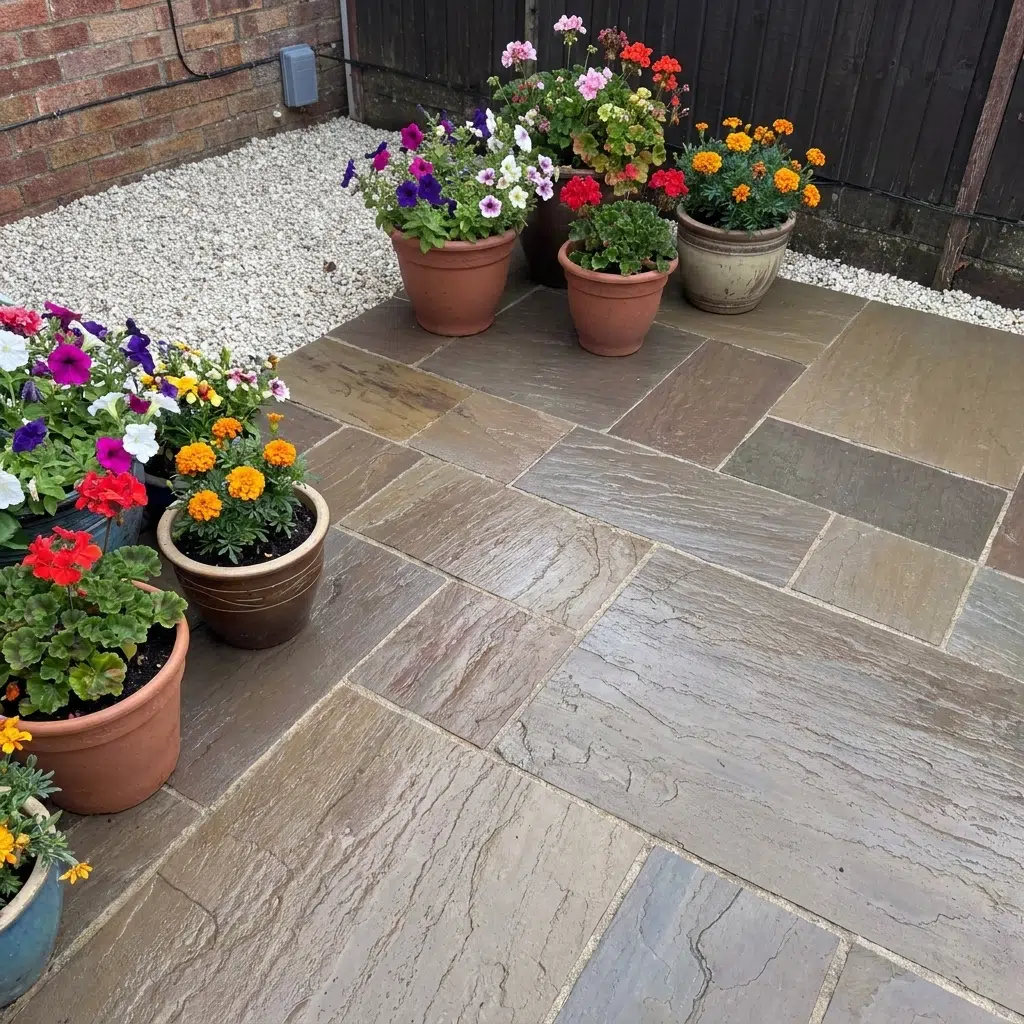
Varied Raj Green sandstone paving beside brickwork and terracotta pots of flowers

01 · Courtyard gardens

Make a small space feel considered

In an enclosed courtyard, paving is a large part of the view. A restrained stone palette, pots and one generous planted border can feel calmer than several competing surfaces. Natural texture adds interest without needing a busy pattern.

Explore the design details

Try a soft grey or warm buff sample against the surrounding walls. A simple rectangular format can work in a small space; the useful test is whether furniture fits and awkward slivers can be avoided at the edges.

Keep a clear route through doors and around chairs. Check shaded corners for drying and drainage, and allow space for planting rather than paving every available inch.

Explore limestone paving or compare sandstone colours.
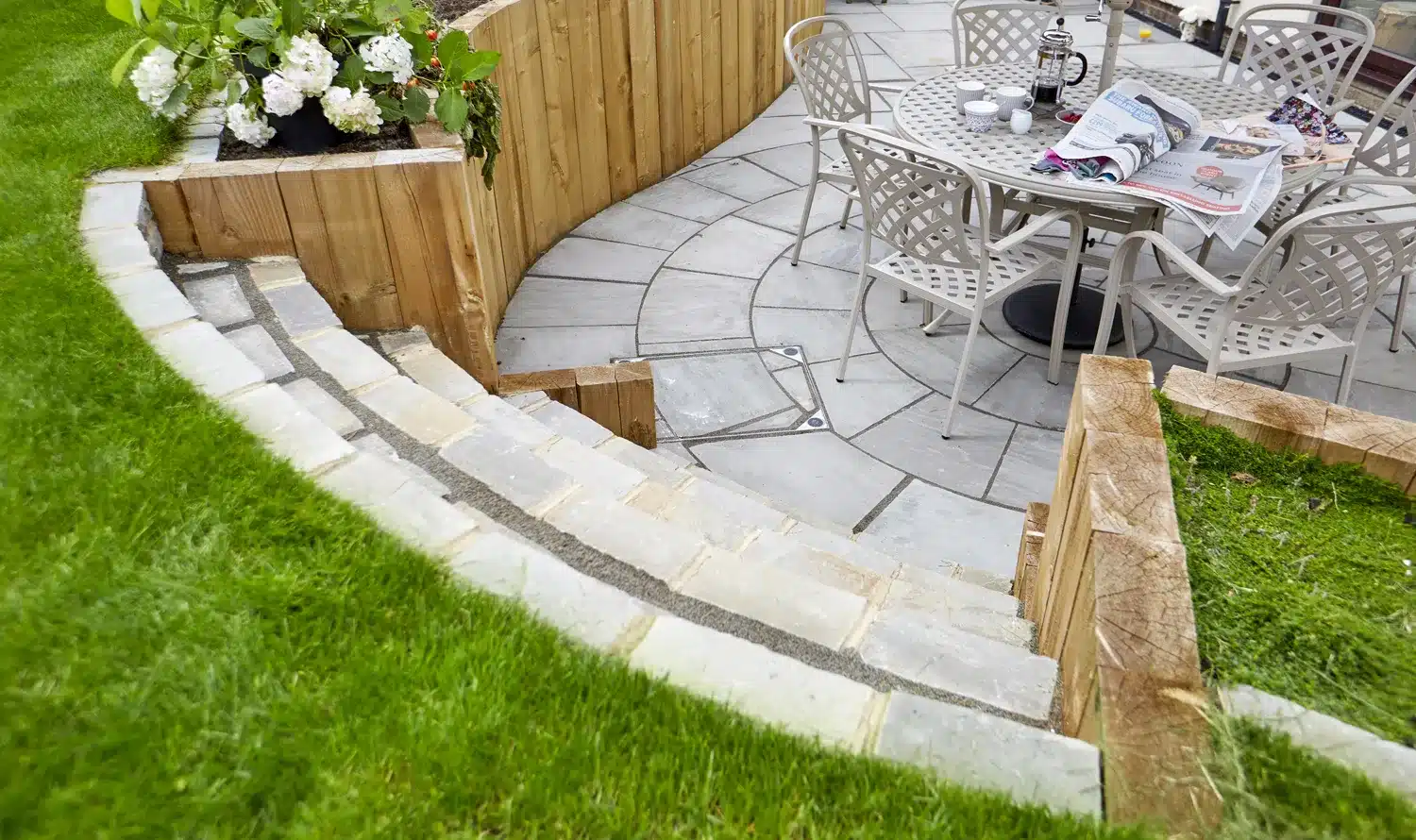
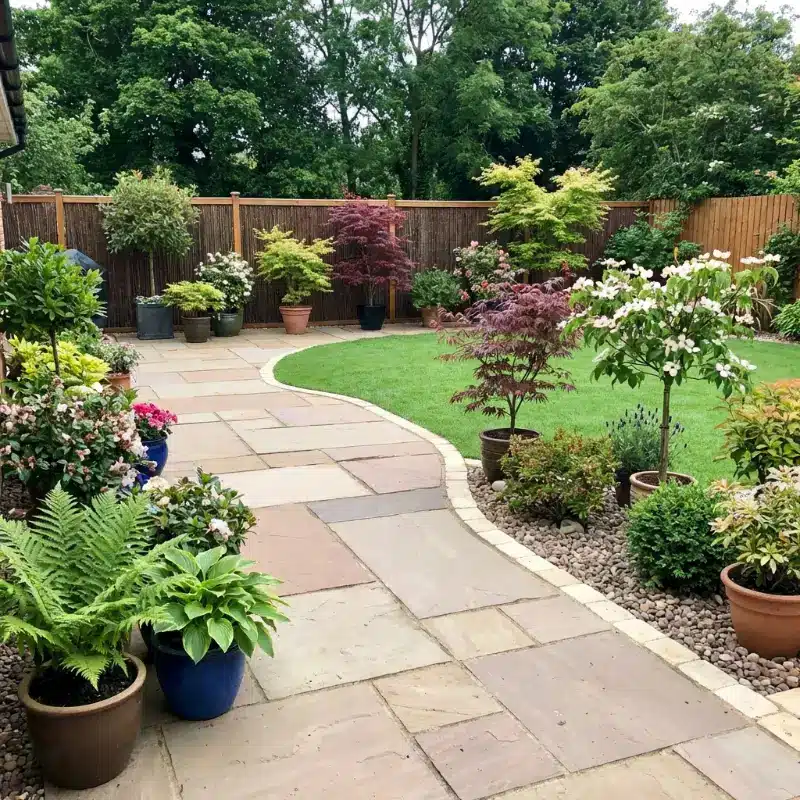
Natural stone circular seating area with garden furniture, timber edges and flowering planting

02 · English country gardens

Let the planting lead

A country garden benefits from a comfortable terrace that connects to lawns and deep borders. Varied sandstone, a quiet joint colour and a curved edge can soften the meeting point between the house and garden.

Explore the design details

Consider mixed-size paving near the house and a smaller seating area further into the garden. A circle can provide a focal point, but check its usable diameter with the table and chairs pulled out before ordering.

Repeat a stone or edging detail along the paths to connect the spaces. A border of setts can define a curve without introducing another dominant material.

Browse natural stone paving circles and sandstone setts.

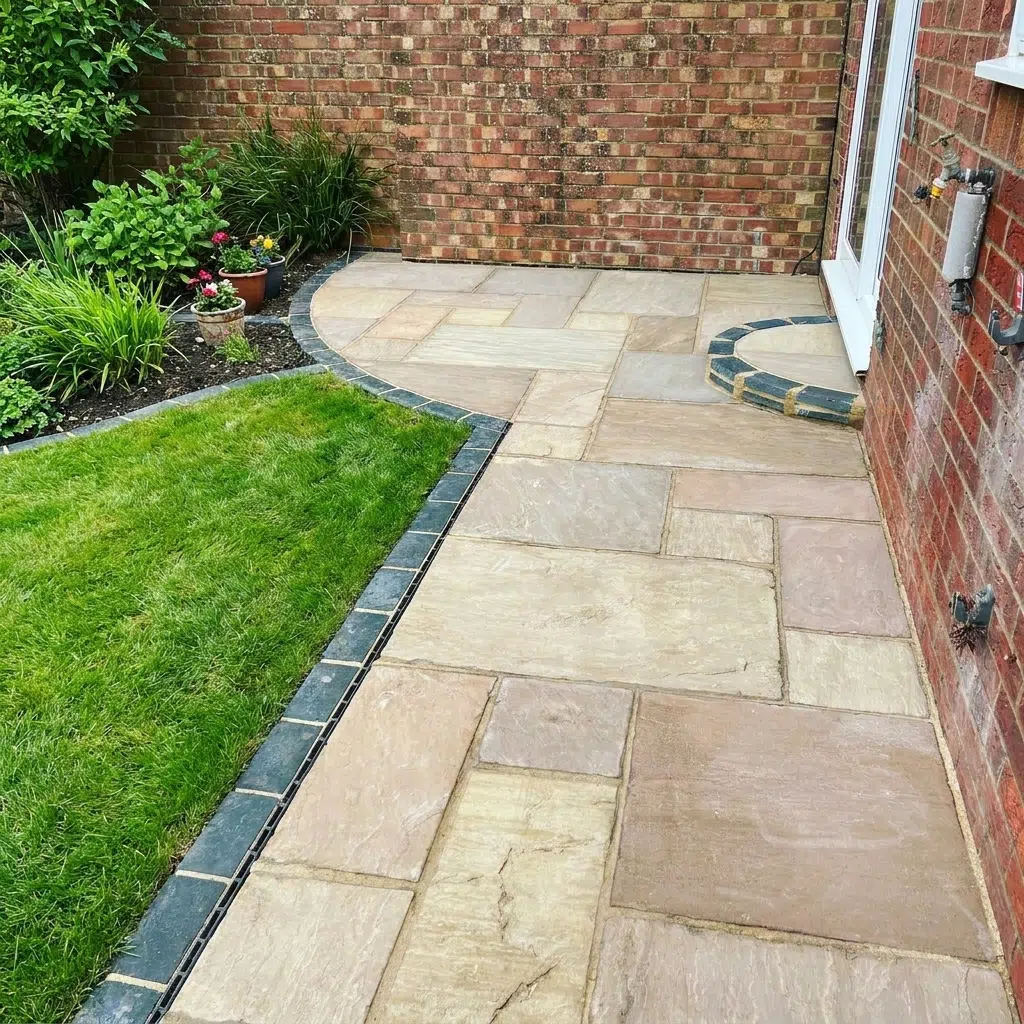
Mixed-size sandstone patio with a curved dark sett edge beside a red brick house and lawn

03 · Cottage & old English-style gardens

Work with the character of the house

Handcut edges, riven surfaces and earthy colour blends can sit naturally beside older brickwork and cottage planting. The aim is a patio that feels settled into its surroundings, with enough restraint to let the building remain the focus.

Explore the design details

Look at the existing local materials before choosing. Buff, brown, grey and green tones can each work, depending on the house. A simple mixed-size layout and sympathetic joints often feel more convincing than several decorative motifs.

Retain sound existing stone where practical. Avoid assuming that new stone is a match for historic paving simply because its colour name is similar.

Compare Raj Green sandstone and read our sandstone colour and finish guide.

Choose in the setting that matters. Put samples beside your walls, doors and planting, then view them wet and dry.

Compare natural stone samples

For context on regional materials and character, see Historic England’s regional materials guidance.

03 / Build your shortlist

Which natural stone should you choose?

Stone names describe broad families. Colour, texture, strength and maintenance still depend on the particular product and finish. Use this table to narrow your shortlist, then check samples and the product information.

A design-led starting point for patios and paths
Stone Design character What to check
Sandstone Varied earthy blends or quieter greys; riven and smoother finishes for relaxed gardens. The full colour range, face texture, thickness tolerances and layout of mixed-size packs.
Limestone Options from pale and warm shades to deep charcoal; useful for a restrained courtyard palette. Expected weathering, finish and care. Dark limestone can lighten; acidic cleaners can damage limestone.
Granite A granular appearance that can suit crisp terraces or traditional sett detailing. The precise surface finish, wet slip evidence, edge detail and suitability for the proposed loads.
Slate Distinctive layered texture and tonal variation; useful alongside timber and green planting. Exterior suitability, surface variation, thickness and product-specific installation requirements.

Our limestone colours and finishes guide explains the individual ranges. If charcoal is on your shortlist, read the black limestone weathering and sealing guide before deciding.

04 / Look closer

Finishes, edges, thickness and samples

Riven, honed, handcut or sawn?

A riven face has natural surface variation; a honed finish gives a smoother appearance. Handcut edges can create a softer, more traditional outline, while sawn edges lend themselves to cleaner joint lines. Surface finish and edge treatment are separate choices.

Check how the surface feels under a chair leg and along the main walking route. A rustic appearance should still be compatible with safe, comfortable access.

Calibration is not a perfectly flat face

Calibrated stone is worked towards a nominal thickness, usually from the underside. The natural face may still vary. Check the listed thickness and tolerances rather than assuming every slab is exactly the same. Our ranges include different specifications; one 22mm patio slab does not establish the requirements for every project.

Confirm suitability separately for driveways, raised systems, heavy planters or hot tubs. Thickness alone is not a load rating.

Check appearance and performance separately

View several pieces where possible: one small sample cannot represent every vein or shade. Compare dry and wet appearance outdoors, and agree how the installer will blend pieces from different parts of the delivery. Natural Paving’s guide to understanding natural stone explains why variation is part of the material.

Texture is not proof of slip resistance. Ask for evidence for the exact finish and intended conditions, particularly on slopes or frequently wet routes. HSE’s slip-resistance guidance explains the value of appropriate testing. Algae and ice still need attention on any paving.

05 / Proportion & detail

Choose the layout before the quantity

Mixed-size packs can give an informal, established appearance. Plan around the actual size combination and suggested pattern; a pack is not an unlimited supply of whichever slab happens to fit next.

Single-size rectangles can create a quieter layout, even in a cottage garden. Set out the direction against the main doorway and longest edge, and test where cuts will fall. Large slabs are not automatically unsuitable for a small courtyard.

Circles, setts and steps work best when they have a purpose: a seating destination, a neat curve or a clearly resolved change in level. Compare the thicknesses and finishes of adjoining products before buying. See our natural stone step options.

A useful planning exercise: mark the proposed patio edge and furniture positions on the ground. Pull chairs out, walk between doors and borders, and check where bins or garden equipment need to pass. Adjust the usable space before calculating the order.

Keep the number of competing materials and joint colours under control. For more layout ideas, read our patio design guide.

06 / Price the whole project

What does a natural stone patio cost?

The slab price is only one part of the budget. The delivered order depends on the stone, finish, quantity and pack options; the installed price also depends on access, ground conditions, detailing and labour.

  • Paving and finishing: slabs, agreed cutting allowance, edging, steps and jointing.
  • Groundwork: lifting old surfaces, excavation, spoil removal, sub-base, bedding and drainage.
  • Installation: labour, cutting, equipment, access arrangements and any changes in level.
  • Delivery and aftercare: applicable charges, storage, cleaning and a compatible sealer if specified.

Ask installers to quote against the same drawing and scope. Check whether waste disposal, drainage, VAT and final cleaning are included. For current paving prices, compare products in the natural stone range and use the quantity controls on the individual product page.

Before buying new materials, consider what can stay. Retaining usable paving or reusing it in another part of the garden can reduce both the order and the work. The RHS recommends considering reuse and material choices; natural stone is not automatically the lowest-impact option in every project.

07 / What lies underneath

Excavation depth, drainage and support layers

The excavation depth comes from the agreed construction, not a single number for all patios. Ground conditions, loads, drainage and finished levels must be assessed before work starts.

A conventional mortared patio: the layers to discuss

Concept diagram, not to scale. Your installer must specify the materials and dimensions for the site and paving.

1 · Natural stone paving

The specified slab thickness and joint arrangement.
2 · Compatible bonding primer

Applied as required by the paving and bedding system.
3 · Full supporting mortar bed

Continuous support beneath each slab, rather than isolated spots.
4 · Compacted sub-base

Suitable graded material, built and compacted in layers.
5 · Separation where specified

A suitable geotextile only where the ground design requires it.
6 · Prepared formation

Stable ground at the agreed excavation level.

Illustrative depth calculation: 22mm paving + an assumed 40mm finished bedding layer + 100mm compacted sub-base = 162mm below the proposed finished surface. This is arithmetic to show the method, not a specification for your garden; weak ground or different loads can require a different build-up.

Agree finished levels and falls towards an appropriate drainage destination before excavation. Conventional paving is generally kept at least 150mm below a building’s damp-proof course; level-access thresholds need a designed detail. Manufacturer guidance also requires full support and suitable joints. See Marshalls’ natural stone installation guidance and our installation guide.

A stone that absorbs some water does not make the finished patio permeable. The joints, bedding and foundation must work together for infiltration; the RHS explains permeable paving construction.

08 / Measure with the layout

How much natural stone paving do you need?

For a rectangle, multiply length by width in metres. Divide an irregular patio into simpler shapes and add their areas, taking care not to count overlapping parts twice. Subtract only areas that will genuinely remain unpaved.

A 5m × 5m patio is 25m². An illustrative 10% allowance takes the planning quantity to 27.5m². Curves, diagonal layouts, narrow cuts and selection preferences may change the allowance, so agree it with the installer.

Use the product’s advertised coverage and ordering information. Our coverage figures include recommended joints; multiplying nominal slab dimensions alone may not reproduce the listed pack coverage. Mixed-size packs also need the right size combination to complete the intended pattern.

Check our cuts, wastage and damages guidance and split-pack information. Decide whether to keep a few suitable spare pieces for future repairs, and order the main project quantity together.

09 / Turn measurements into an order

How to use our natural stone paving calculator

Each product has its own pack options and quantity controls. This example uses our Raj Green 22mm sandstone in 600 × 900mm. It shows the calculation process; open the product page for its current specification, availability and total.

Worked example · 5m × 5m patio

Order by m²

Raj Green sandstone · 600 × 900mm

Square metres entered25 m²
ON

Include the recommended 10% for cuts and wastage

Enter the measured area first. Do not add the same allowance twice.

Example displayed result

27.50m²Including the selected allowance
51Slabs shown for this example

Slab quantities and pack combinations depend on the selected product.

Illustration of the product calculator, checked on this product. This panel is a worked example; use the linked product page to calculate your own order.

Follow these four steps

  1. Open the exact product. Check size, thickness, finish and the available full or smaller packs.
  2. Enter your measured area under “Order by m²”. For this example, enter 25. Alternatively, compare the offered pack quantities.
  3. Choose your cutting allowance once. Switch on the 10% option if it matches the allowance agreed for your layout. If your entered quantity already includes that allowance, leave it off.
  4. Review the displayed total and slab quantity. Compare with the laying plan and pack information before ordering. Ask our team about a mixed-size layout or a different required allowance.

Open the Raj Green product calculator →

The calculator helps translate measurements into a product quantity. It does not assess ground conditions or design the laying pattern.

10 / Before the paving arrives

Ordering, delivery and inspection

Confirm the product, quantity, finish and delivery arrangements before booking installation. Natural stone varies between pieces and batches, so buying the whole project together is preferable to relying on an exact later match.

Check vehicle access, the unloading method and where pallets can be placed. A narrow lane, gravel drive, slope or restricted frontage can affect delivery; discuss the actual site with our team rather than assuming pallets can be moved to the back garden. Read our delivery information.

Inspect the delivery promptly and raise any concerns before laying or applying treatments. Natural markings are expected, but the product and quantity should match the order. Review the variation across the delivery and blend it during installation rather than creating separate light and dark patches.

Our UK-based team can help with quantities and product choices, backed by the practical experience of Natural Paving Installations. Contact us with your measurements, preferred stone and photographs of the access or garden.

11 / Living with natural stone

Weathering, cleaning and sealing

Stone can mellow with exposure, and a changing surface is part of its appeal. That does not mean leaving slippery algae, leaf stains or spills untreated. Decide whether you like the expected weathered appearance before choosing the material.

A simple care routine

Sweep leaves and debris, deal with spills promptly and use a cleaner confirmed as suitable for the exact stone and jointing. Test any treatment discreetly first. Avoid assuming that a general patio cleaner, brick acid or aggressive pressure washing is safe for the surface.

Acidic products are particularly unsuitable for limestone and can also discolour or damage other stones. Check the paving and treatment manufacturers’ instructions rather than treating all natural stone alike.

Does natural stone need sealing?

There is no single answer for every stone. Discuss the product, location and desired appearance with the supplier and installer. A compatible sealer may help with particular staining or appearance requirements, but can alter colour and needs its own application and maintenance regime.

For dark limestone, compare natural weathering with any proposed colour-enhancing treatment before deciding. Read our black limestone care guide. Sealing does not replace sound drainage, correct installation or routine cleaning.

12 / The finer points

Natural stone buying questions, answered

Is natural stone better than porcelain for a traditional garden?

It can be a particularly good fit when you want individual markings, softer edges and an appearance that changes over time. A quieter porcelain design can also work with a period house. Compare samples against the building and balance the visual result with maintenance; see our material comparison.

What paving works best in a small courtyard garden?

Start with the walls, light and usable floor space. A restrained limestone or sandstone palette can work well, but finish and drainage matter as much as colour. Check the table-and-chair footprint and keep room for planting. Small gardens do not automatically need small slabs.

Will every natural stone slab look like the sample?

No. A sample indicates part of the colour and texture range. Natural variation, veins and markings are expected, and the overall effect comes from the blend. Review several pieces or a larger laid example where possible.

Is natural stone paving slippery when wet?

The answer depends on the exact stone, surface, conditions and contamination. Neither “natural” nor “riven” guarantees slip resistance. Ask for relevant product test information and keep routes clear of algae, leaves and ice.

Can natural stone be laid directly on soil?

A conventional mortared patio needs a designed foundation and continuous support. Laying slabs directly on soil is not a substitute for that construction. Separate stepping-stone or specialist systems need their own suitable details.

How much extra paving should I order?

Around 10% is a useful starting point for many layouts, but cuts, curves and size combinations can change it. Agree the allowance against the drawing, then use the product’s coverage and calculator. Do not add 10% manually and switch on the same calculator allowance as well.

Can I use this paving for a driveway?

Do not assume a pedestrian patio slab is suitable for vehicles. Ask for confirmation of the exact paving specification and a construction designed for the expected loads before ordering.

Is natural stone automatically a sustainable choice?

No. Quarrying, processing, transport, installation and useful service life all affect the comparison. Keeping or reusing suitable existing material may be a better first step than replacing it. Natural stone sold by a UK company is not necessarily quarried in the UK.

Your next step

Find the stone that belongs in your garden

Shortlist two or three finishes, compare them at home and bring the layout and measurements together. We can help you move from a design idea to a practical paving order.

Explore natural stone paving